Living in Catania: The City That Works, at the Foot of Etna

Built in black lava stone at the foot of Europe's largest active volcano, Catania is the Sicily that never stops: black and Baroque, young and Mediterranean, with an airport that keeps it tied to the world. The city for those who want to live the island without giving up urban energy.

This article covers:

This article covers:

Make us your preferred source on Google
In short

Catania is the capital of eastern Sicily, at the foot of Etna, and the island’s most dynamic city in economic and academic terms. A one-bedroom flat rents for €400-600 a month. The airport passed 13 million passengers in 2025 and is the busiest in southern Italy, while the international community is sustained in part by the NATO base at Sigonella. A university city with a UNESCO Baroque centre, it suits anyone after city life, connections and affordable prices.

Why choose Catania to move to Sicily?

Many Sicilians consider Catania the island’s true engine. It stretches along the Ionian coast at the foot of Etna, a city of contrasts: black lava stone and Baroque gold, loud markets, monumental squares and a nightlife that never stops. Those who choose it aren’t after the postcard, but the energy of a living city.

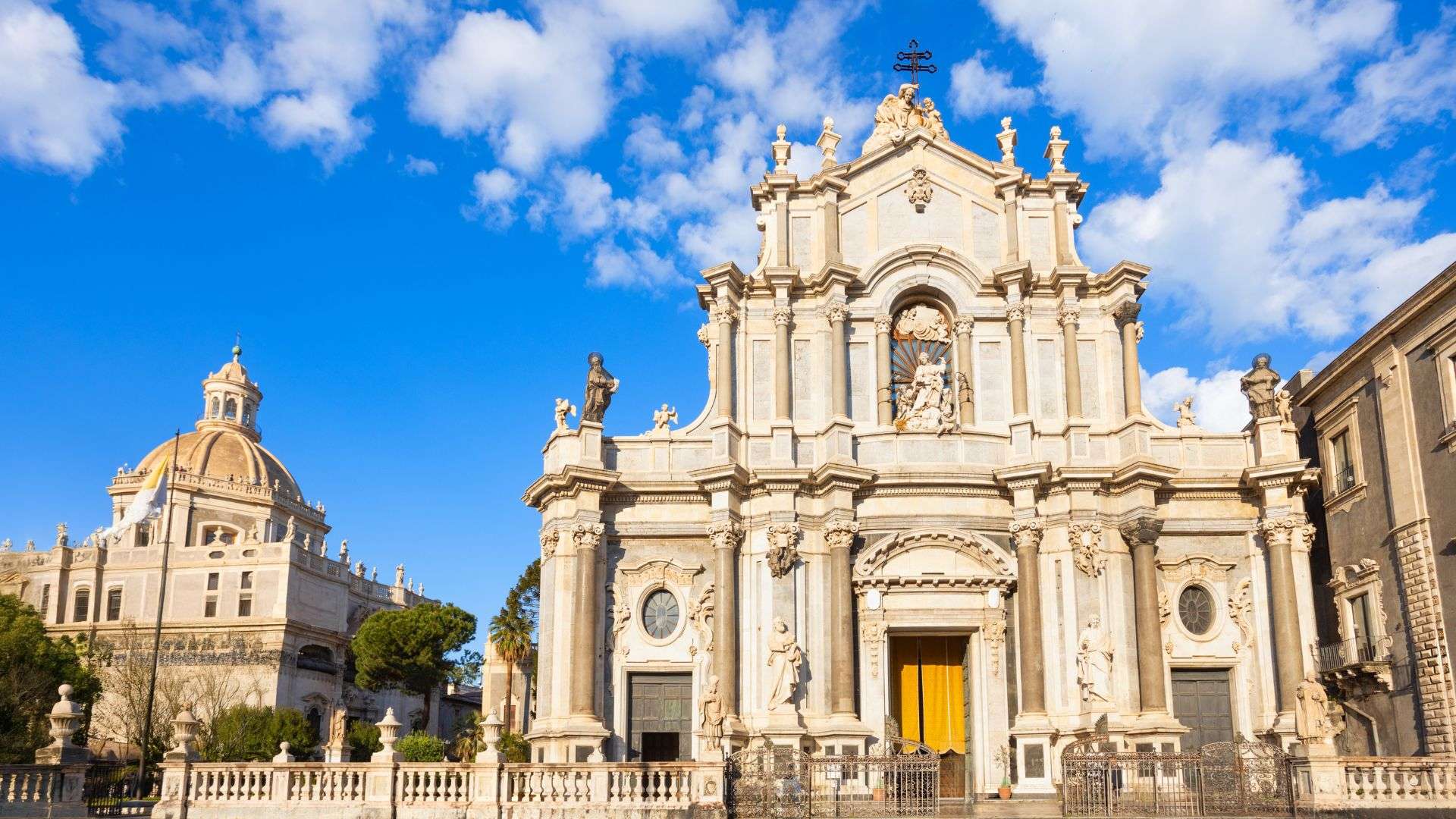
Its very stone tells a story. Catania is black because it was rebuilt with Etna’s lava after the 1669 eruption and the 1693 earthquake. It rose again on a geometric, unified urban plan, with Piazza Duomo at its centre and the Elephant Fountain — u Liotru in dialect — the affectionate symbol of a city used to being reborn.

That rebirth is today a UNESCO World Heritage Site: since 2002 Catania has been one of the eight Late Baroque towns of the Val di Noto. Via Crociferi, the “street of churches”, bears witness to it, with Baroque façades of rare beauty succeeding one another in under two hundred metres, alongside Palazzo Biscari and the Badia di Sant’Agata.

Catania is also a university city. The University of Catania, founded in 1434 and among Italy’s oldest, has its central seat, the Palazzo Centrale, in Piazza Università; the Monastero dei Benedettini, one of the largest monastic complexes in Europe, houses its Department of Humanities. The strong student presence gives the city a youthful energy.

For those arriving from abroad, in short, Catania combines three things rarely found together: full urban services, an affordable cost of living, and air links no other Sicilian city can match.

There is one contrast locals take for granted and newcomers never expect: from the lava rocks of San Giovanni li Cuti, inside the city, to the Rifugio Sapienza at almost 1,900 metres it is thirty-two kilometres and forty-four minutes by car. In the same day you can have breakfast facing the sea and walk on snow. It is this double nature — lava reaching the water on one side, a snow-capped volcano on the other — that shapes daily life here far more than the Baroque centre does.

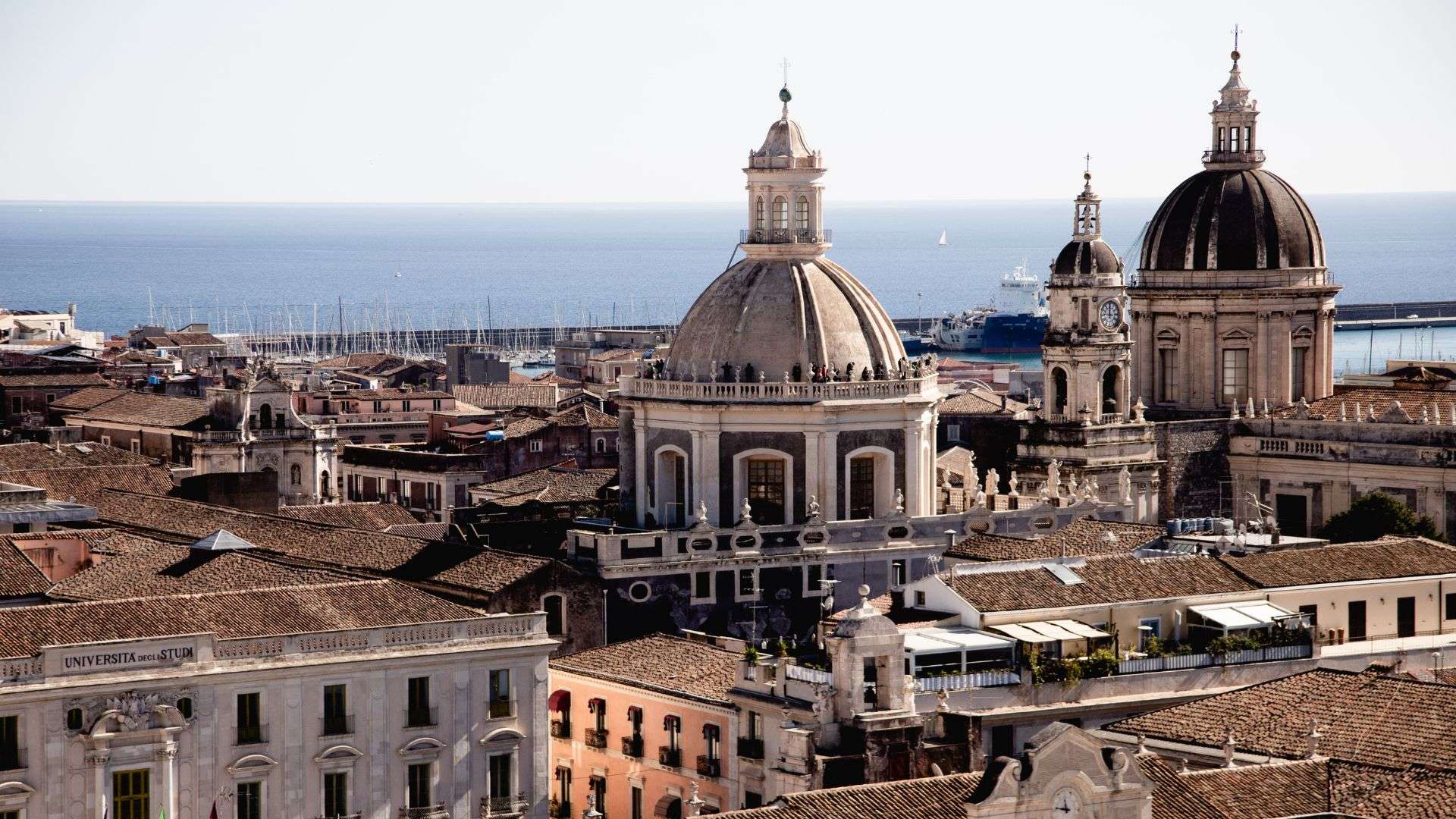
Lo skyline di Catania con l'Etna sullo sfondo
The Catania skyline: the domes of the Baroque centre, the harbour and the sea, with the university building in the foreground

Which neighborhoods are best to live in Catania?

Catania’s neighborhoods have very different characters, and the choice radically changes how you live the city.

The historic centre, around Piazza Duomo and Via Etnea, puts everything within walking distance: the Pescheria fish market, Castello Ursino, Villa Bellini and the Teatro Massimo Bellini are ten to twenty minutes apart on foot. It’s the choice for those who want to live immersed in the city.

The Antico Corso, around the Benedictine Monastery, is the liveliest area after dark: among bookshops, workshops and bars, street life goes on until late. Corso Italia and the Borgo, by contrast, are the more elegant residential areas, with tree-lined avenues and shops. Toward the sea, Ognina and San Giovanni li Cuti are the old fishing villages: small harbours, black lava cliffs, a daily relationship with the water.

The city’s university dimension is an asset for newcomers too. The University of Catania welcomes around 700 international students a year, with over a hundred Erasmus students from dozens of countries and ten master’s degrees taught entirely in English, plus free English and Italian courses for foreigners. For a student choosing Catania, finding accommodation, classes and a young community is easier than in many other cities on the island.

How much does it cost to live in Catania?

Catania is still one of Italy’s cheapest cities, but the gap between districts is wide and averages alone say little. In June 2026 the average asking rent in the city is €10 per square metre per month: a 55-square-metre one-bedroom therefore sits around €550, with the historic centre and the Ognina seafront above €600 and Librino, Nesima and San Giorgio below €400. Students get the biggest advantage: Catania and Messina are the two cheapest university cities in Italy for a single room.

Monthly itemCatania, 2026Note
Single room for studentsaround €284the lowest in Italy with Messina (March 2026)
One-bedroom, outer districts€350-450Librino, Nesima, San Giorgio, Galermo
One-bedroom, semi-central€480-560Borgo, Cibali, Picanello
One-bedroom, centre and seafront€580-650historic centre, Corso Italia, Ognina
Groceries, one person€250-320estimate based on ISTAT data for Sicily
Utilities (electricity, gas, water)€75-110yearly average; air conditioning weighs in summer
Waste tax and broadband€40-60Catania has the highest waste tax in Sicily
Total, one person in outer districtsaround €900bare-bones budget
Total, one person in a central area€1,100-1,250with eating out and a social life

Indicative values recorded between May and June 2026 on Italian property portals, with the other items estimated from ISTAT and ARERA data. They change by area, condition and season: the rent on any single flat should always be checked locally. The single-room figure is the average asking price in listings and is not necessarily inclusive of utilities.

Where newcomers actually live: the ring towns and the slopes of Etna

Something the guidebooks miss: many foreigners who choose Catania do not live in Catania. They live in the ring of towns that climbs from the sea to the volcano in about twenty kilometres, where houses come with gardens, summers are cooler and prices are often below those of the centre.

The geography is all in the height gain. Aci Castello sits at 17 metres above sea level, Nicolosi at 702: in between lie the inner ring towns — Sant’Agata li Battiati, San Gregorio, Gravina, Tremestieri, San Giovanni la Punta, Mascalucia — now a continuous urban fabric with the city, and above them the true Etna villages, where the countryside takes over.

TownAltitudeBuying €/m²From CataniaCharacter
San Gregorio di Catania333 m1,78410 minThe priciest in the ring
Sant’Agata li Battiati320 m1,57610 minResidential, well served
San Giovanni la Punta352 m1,44415 minVillas and greenery
Viagrande404 m1,46221 minEtna DOC vineyards
Trecastagni568 m1,40721 minEtna village, wineries
Mascalucia418 m1,30820 minPopulous, full services
Pedara605 m1,30825 minCool in summer
Nicolosi702 m1,28924 minThe gateway to Etna South
Zafferana Etnea587 m98632 minHoney, chestnuts, the cheapest

Asking values recorded in June 2026 on Immobiliare.it; altitudes are those of the town hall and driving times are calculated from Piazza Duomo in free-flowing traffic. In the smaller towns the sample of listings is thin, so annual changes should be read as orders of magnitude. Populations are ISTAT estimates at 1 January 2026, with final figures due in December 2026.

Two practical readings. First: Gravina di Catania has almost 5,000 residents per square kilometre, three times the density of Catania itself — here “outside the city” does not mean countryside, it means another city attached to the first. Second, about summer: the higher you go, the cooler it gets. At Nicolosi, seven hundred metres above sea level, it is roughly four degrees cooler than on the seafront, and in August you sleep with the window open instead of the air conditioning on. That is why those who can move up to Trecastagni, Pedara or Zafferana Etnea, the most affordable town in the table, a good half hour of bends from the city. The flip side comes in winter: colder days, higher heating bills and services further away.

Silver Move

Considering the move as a retiree? The Silver Move path guides foreign and returning retirees: choosing the area, the Elective Residency Visa, healthcare registration and practical formalities.

Then there is the wine. Etna DOC was recognised in 1968, the first controlled designation of origin in Sicily, and its vineyards run between 200 and 900 metres, reaching 1,100: among the ring towns, Viagrande, Trecastagni, Pedara, Nicolosi, Zafferana, Aci Sant’Antonio and Acireale are inside the appellation. Carricante for the whites, Nerello Mascalese for the reds. Living here means having wineries as neighbours and the harvest as a season, not an excursion.

What is it like to live in the shadow of Etna?

Living in Catania means having Europe’s most active volcano as a next-door neighbour. Etna isn’t a backdrop: it’s a daily presence, visible from almost every street, changing colour with the seasons and now and then dusting cars and balconies with a fine black ash.

In 2024 and 2025 the volcano went through repeated eruptive phases, with spectacular lava fountains and, on some days, the temporary closure of the airport because of ash. It’s worth knowing honestly: it’s an occasional inconvenience, managed with established protocols, not a danger to the city.

In return, Etna gives a great deal. Its volcanic soil nurtures some of Italy’s finest vineyards and orchards, and its slopes offer Catanesi hikes and skiing half an hour from the sea. Few cities in the world let you have breakfast by the sea and walk on lava in the afternoon.

The volcano rises above 3,300 metres — the exact height changes with every eruption — and has been a UNESCO World Heritage Site since 2013, inscribed for its geological processes and nearly 2,700 years of documented activity: one of the longest historical records of volcanism in the world. The upper part, 19,237 uninhabited hectares, is the most strictly protected zone of the Etna Park, established on 17 March 1987 as Sicily’s first regional park.

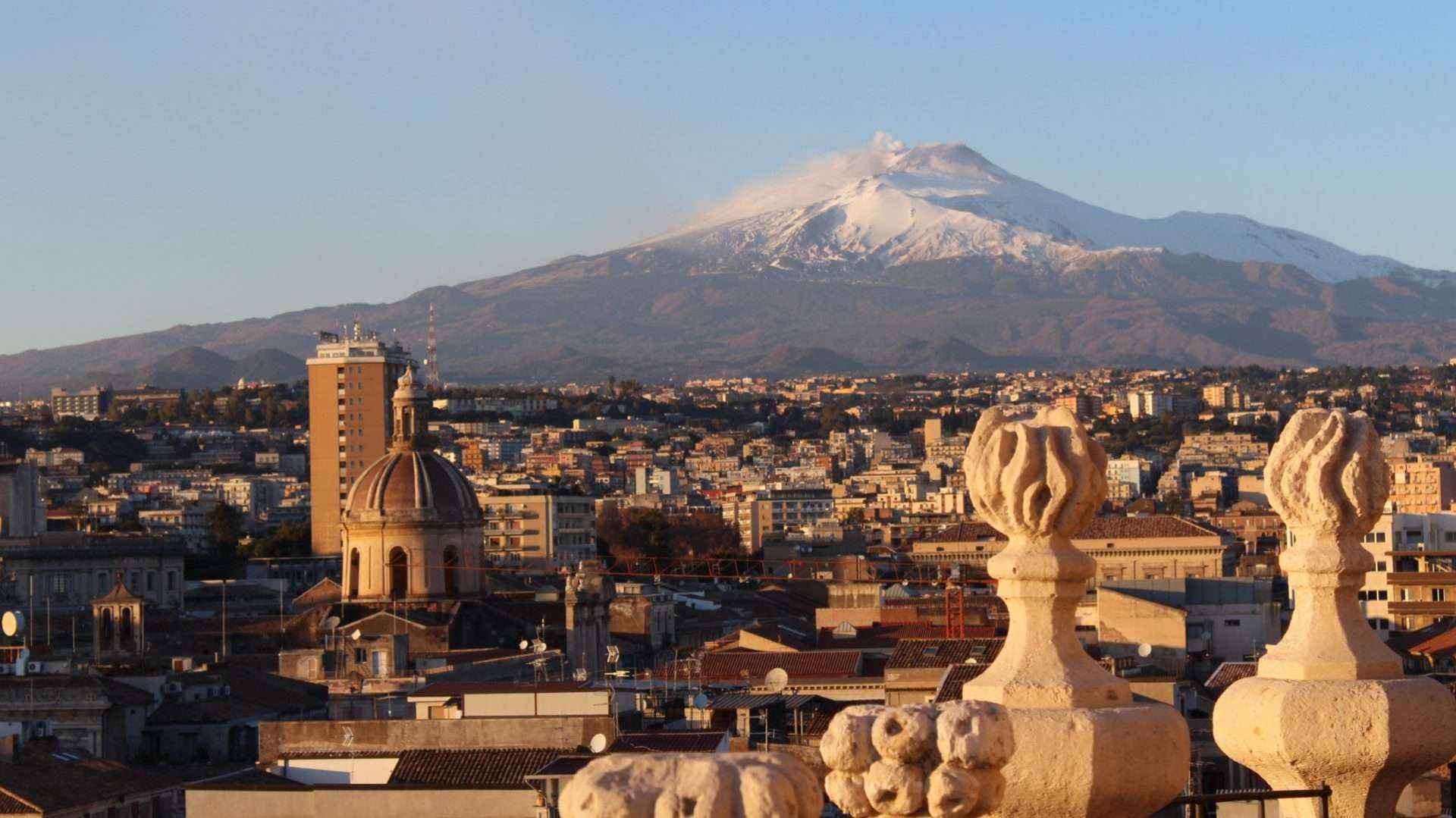
L’Etna innevato visto dai tetti del centro di Catania, con le cupole barocche in primo piano
Etna under snow seen from the rooftops of the old town, with the Baroque domes in the foreground

The practical consequence is a vertical geography: in a little over forty minutes you go from the lava rocks of San Giovanni li Cuti to the 1,900 metres of the Rifugio Sapienza, where the cable car climbs higher still. In winter there is skiing on Etna’s northern side, on small lifts and in seasons that depend on the year’s snow. But that is not the point: the point is that real mountains are half an hour by car from the sea, and you look at them from the window every day.

And the sea? Locals smile at newcomers who turn up in April with a swimsuit: the water is still around sixteen degrees, colder than in January. The real season is long at the end, not at the start: in October the sea sits around twenty-four degrees, warmer than in June. You swim when elsewhere the beach umbrellas are long gone and, in the same month, looking up, the summit may already be white.

Il Duomo di Catania in piazza Duomo, costruito in pietra lavica
The Cathedral of Sant'Agata in piazza Duomo, with the dome of the Badia di Sant'Agata to the left

Living with the ash

This, more than lava, is the daily reality here. When Etna emits ash, a black dust settles on cars, balconies and streets, and it has to be cleared: cleaning roofs and terraces is the owner’s responsibility, while the councils organise collection points with strict rules on how and where — small bags, never mixed with other waste. On ashfall days, ordinances cut speed limits and ban motorbikes and bicycles, because ash on asphalt is as slippery as gravel.

There is a less obvious effect, documented in a study by Italy’s National Institute of Geophysics and Volcanology: the air quality problem is not the ash that falls, but the ash that cars grind up as they drive over it. After a lava fountain, roadside particulate levels have been measured at ten to twenty times the European limit, and the effect lasts for days after the eruption ends, until the ash is removed.

At the airport the impact is recurrent but almost always brief: recent years have seen two to four episodes annually with flights reduced or suspended, concentrated between February and August. They usually resolve within hours through restricted arrivals; long closures are the exception, like the one in early July 2026, which halted the airport for around thirty-eight hours. People who live here learn not to book tight connections.

Two points that matter if you are buying. First: home insurance does not cover eruption damage — the exclusion is explicit even in catastrophe extensions, and the insurance obligation introduced for businesses does not apply to homes and does not cover volcanic risk in any case. Second: in August 2024 the Italian government rejected a request for a state of emergency over the ash precisely because, as the INGV certified, pyroclastic fallout in the Etna region has long been an ordinary phenomenon. Living here means accepting that it is routine.

How connected is Catania? Airport and getting around

Here Catania has no rival in Sicily. Vincenzo Bellini airport at Fontanarossa is southern Italy’s busiest and Italy’s fifth, with over 13 million passengers in 2025 and capacity expanding toward 15 million. In 2026 nearly fifty airlines link it to around a hundred destinations: direct flights to Paris, London, Berlin and Istanbul, a non-stop connection to Dubai, and the dense low-cost network of Ryanair, Wizz Air and easyJet to dozens of European cities. And from 2026 Catania has its first direct transatlantic flight: Air Canada links it seasonally to Montréal on the Boeing 787, opening direct access to North America and, through its hubs, to the United States.

For remote workers or anyone keeping ties abroad, this changes everything: it means being able to go “home” or receive visitors without the long transfers that penalise other parts of the island. The road network also links Catania quickly to Messina and Siracusa.

Is Catania right for a remote worker?

Yes — it may be the most suitable Sicilian city. The air connectivity, a growing number of coworking spaces, an urban life of cafés, culture and restaurants, and the closeness of both sea and Etna make it a practical base for working online. Our Nomad Landing service is designed to support remote workers through the move.

There’s also a side few expect from Sicily: Catania is the Etna Valley, one of Europe’s leading semiconductor hubs. Around STMicroelectronics — building a multi-billion-euro plant here for silicon-carbide chips — and a tech district born in the 1960s, research centres, multinationals and open-innovation programmes have grown up. For anyone working in digital or high-tech it means a real ecosystem to plug into, not just a nice place to log on from.

The city also hosts an international community — less conspicuous than the tourist crowd but concrete, fed in part by the nearby NATO air-naval base at Sigonella. Finding English-speaking contacts here is easier than in the inland towns.

Nomad Landing - for remote workers

Want to work from Catania while keeping your job or your clients abroad? With Nomad Landing we check which visa or permit fits your situation, handle residency, tax code and the first bureaucratic steps, and clarify where you will pay tax.

What does a local do that a tourist never sees?

Living in Catania means entering habits no guidebook tells you about: everyday gestures of a Catanese, not of a passing tourist, that reveal the city’s character.

It starts with food. On Via Plebiscito the ritual is arrusti e mangia: braceries grill slices, meatballs and horse sausage over charcoal, and the meat is eaten hot, standing, with your hands. In the morning, granita with a brioche col tuppo — almond, mulberry, pistachio — is a full breakfast, even at dawn in summer. To cool off on scorching days there’s the kiosk, a city institution since 1896: at the counter you order a seltz, limone e sale, to be drunk in one go. And the real shopping happens at dawn in the Pescheria‘a piscaria, behind Piazza Duomo — amid vendors’ cries and haggling: theatre more than market.

Then there’s the Catania that lies beneath. Under Piazza Duomo you descend into the Roman Achillean Baths, fed by the Amenano river that flows hidden under the city and resurfaces in the fountain known as acqua a linzolu; a little further up, in Piazza Stesicoro, a large trench reveals the 2nd-century Roman amphitheatre, second in size only to the Colosseum. Those who really want to feel they belong go to the stadium on Sunday: a Catania match in Serie C, at the Massimino — ‘il Cibali’ to everyone — says more than a thousand words.

At the weekend the Catanese heads to the sea: from Aci Trezza — technically Aci Castello, but fifteen minutes from home — you take a boat out to the Faraglioni dei Ciclopi and Isola Lachea, over the black lava sea Verga made eternal in I Malavoglia. And if there’s one moment when the city truly stops, it’s Sant’Agata: from 3 to 5 February, amid the fercolo, the candelore, devotees in white sackcloth and the typical sweets — minne di Sant’Agata and olivette — Catania celebrates one of the world’s largest religious festivals.

For the sea and the villages north of Catania — from Aci Trezza to Acireale — our piece on Living in Taormina and the Ionian coast tells the story of the whole Riviera dei Ciclopi.

How the year changes in Catania

Anyone arriving from northern Europe soon realises that here the year is measured in fixed appointments rather than in seasons. One stops the city for three days, one brings snow half an hour from home, one opens the sea when elsewhere it closes, and one fills the Etna villages with crates and tractors. Knowing when they fall explains daily life better than any climate average.

February: the city stops for Sant’Agata

From 3 to 5 February Catania celebrates its patron saint, and for three days everything else comes second. On the 3rd there is the candle-offering procession and fireworks in Piazza Duomo; on the 4th the dawn mass at six and the outer route, which returns deep into the night; on the 5th the pontifical mass and the inner route, ending at first light on the 6th.

At the centre is the fercolo, which locals call the vara: eighteen tonnes, eleven metres long, six high, and no engine. It runs on eight rubber rollers and is pulled by devotees on two ropes measuring 108 and 105 metres — deliberately different lengths, so they do not foul each other on the bends. The silver you see today is not that of 1519: the original was destroyed in the bombing of 17 April 1943 and rebuilt in 1946.

Ahead of it come the candelore, the great carved Baroque candle-towers representing the guilds: fishmongers, greengrocers, bakers, pasta makers, butchers. They weigh between two hundred and eight hundred and sixty kilos and are carried on the shoulders of eight or twelve men with a swaying gait known as the annacata. Their number has grown over the past fifteen years: the cathedral’s own record counts eleven, more recent surveys fifteen.

Devotees wear u saccu, the white cotton robe with a cord at the waist, the black velvet scuzzitta and white gloves, and repeat the cry “Semu tutti divoti tutti? Cittadini, viva sant’Àjita!”. The most awaited moment is the climb of via Sangiuliano, lava paving at around ten per cent gradient: since an accident cost a devotee his life it is no longer taken at a run. The head of the vara crew, though, says the genuinely hard stretch is another one, the Cappuccini climb, three ramps on a curve. In the pastry shops, meanwhile, appear the minne di Sant’Agata, ricotta cassatelle with a candied cherry on top, and the almond-paste olivette.

For three days the city genuinely stops: shops shut, streets impassable, tens of thousands of people dressed in white following the fercolo from dawn until deep into the night. It is one of the most attended religious festivals in Europe, and for those who live here it is the moment Catania recognises itself: see it once and you understand why locals simply call it ’a festa. One clarification is worth making, because you will read the opposite everywhere: the ranking that puts it “third in the world” after Seville and Cusco does not exist — it comes from a 1995 article describing it as one of the three most beautiful, not the largest, and has been repeated ever since without anyone checking. Its actual recognition is on the Sicilian Register of Intangible Heritage, since 13 June 2017, not UNESCO, which in 2013 inscribed four other Italian festivals. None of this takes anything away: the festival stands on what it is, and needs no records.

December to March: snow, but on Etna

It does not snow in Catania: the last significant snowfall in the city dates to 1905. The snow stays above, and from December to March Etna is white and visible from almost every street. What really changes daily life, though, is not the snow but the heating. Catania is in climate zone B, where systems may run for a maximum of eight hours a day from 1 December to 31 March; Mascalucia, Viagrande and Zafferana are in zone C (ten hours from 15 November); Nicolosi, Pedara and Trecastagni in zone D, allowing twelve hours a day from 1 November to 15 April. In practice, living up the mountain means more than twice the permitted hours of the city, over a season six weeks longer.

June to October: the swimming season

The sea at Catania stays above twenty degrees from June to October, and in November sits exactly on the threshold. The administrative bathing season runs from 1 May to 31 October, though the lidos open within the window set at regional level, roughly from early June to mid-September. People who live here work the margins: in October the water is warmer than in June, and the beaches are empty.

Two different seas within a few kilometres: the Plaia, eighteen kilometres of sand lined with beach clubs, and the lava shoreline of San Giovanni li Cuti and Ognina, black pebbles and public solariums, where people swim after work.

October: the harvest on Etna

While the rest of Sicily has finished, the Etna villages harvest in October, and once went into November. The reason is altitude: the vineyards sit between three hundred and fifty and a thousand metres, and the day-night temperature swing delays the ripening of Nerello Mascalese, which must make up at least eighty per cent of Etna Rosso. For a month the roads of Trecastagni, Milo and Zafferana fill with crates, and the wineries open their doors.

July and August: the city empties, then fills

In summer average highs sit between 31.8 and 32.3 degrees and the city stops during the day. Then the sun drops and the opposite happens: the city-run Catania Summer Fest brings over a hundred events across the centre and the outer districts, with an eight-thousand-seat arena in Villa Bellini. Those who can, though, go up: at Trecastagni or Nicolosi you sleep with the window open.

Did you know?

Catania was the birthplace of Vincenzo Bellini, one of the greatest opera composers of the 19th century. The city named its theatre, its airport and even a dish after him: pasta alla Norma, with aubergine, salted ricotta and tomato, takes its name from his most famous opera. To live in Catania is to enter a culture that weaves music, food and identity together inseparably.

Conclusion

Catania isn’t the dream Sicily of empty beaches: it’s a living city, at times rough, that works and doesn’t stop. It’s the choice for those who want to live in Sicily without cutting themselves off — with the airport that brings you back from anywhere, the sea to the north, Etna behind and a cost of living that seems almost unbelievable to a northern European or an American. For a remote professional, or anyone wanting to stay connected to the world, it’s probably the island’s most practical front door.

Sources

Share on:

FAQ

It depends on your priorities. Catania is slightly cheaper, more work-oriented and has southern Italy's main airport; Palermo is the capital, larger and more monumental. Those after efficiency and connections tend to Catania.
The historic centre around Piazza Duomo for everything on foot; Corso Italia and the Borgo for residential elegance; Ognina and San Giovanni li Cuti for the relationship with the sea.
No. Etna is Europe's most active volcano and its eruptions are frequent, but constantly monitored. The impact on the city is mostly ash, which can cause temporary disruption, including the occasional closure of the airport.
Catania Fontanarossa is southern Italy's main airport, with direct flights across Europe and connections to the United States via the major European hubs. In 2025 it passed 13 million passengers.
A one-bedroom costs on average €400-600 a month, slightly less than in Palermo. Historic markets help keep the grocery bill down.
Yes. Air connectivity, growing coworking, urban life and a real international community make it perhaps the Sicilian city best suited to remote work.

DISCLAIMER

The information provided on this website is for general informational and illustrative purposes only. It does not constitute legal, tax, financial or professional advice and should not be relied upon as such.
While we strive to ensure the accuracy and timely updating of all content in accordance with current laws and regulations, we accept no responsibility for any errors, omissions, misinterpretations, or changes in legislation that may occur after publication. Any decisions or actions taken based on the information contained on this website are undertaken at the user’s sole risk.

Our services

Did you enjoy
this article?

Discover how we can help you relocate or invest in Italy with our dedicated services.

Tailored planning to live or invest in Italy.

Property purchase and management in Italy.

Relocation assistance for visas and residence permits.

Support for businesses and investors choosing Italy.

MAgazine

Stay up To Date!

Subscribe to our newsletter to stay up to date with the latest news.