Gangi, Sicily: what to see in the Madonie mountain village

Gangi, Sicily is one of the most scenic villages in the Madonie Mountains. Famous for its medieval layout, honey-colored stone houses and historic palaces like Palazzo Bongiorno, it offers authentic Sicilian culture, religious traditions and panoramic views — an ideal destination for travelers seeking lesser-known places in Italy.

This article covers:

This article covers:

Make us your preferred source on Google
In brief
  • Gangi sits at 1,011 metres on a ridge in the Madonie mountains, inland from Palermo.
  • The comune had 5,918 residents on 1 January 2026 (ISTAT estimate).
  • In 2014 it won “Il Borgo dei Borghi”, the Rai 3 television contest.
  • Palermo and Catania airports are both about one hour and three quarters to two hours away by car.
  • The nearest 24-hour emergency room is in Cefalù; the closest hospital is in Petralia Sottana.
  • In November 2025 a Guardian reader named Gangi as a stop on the Via dei Frati walk.

Why did Guardian readers single out Gangi?

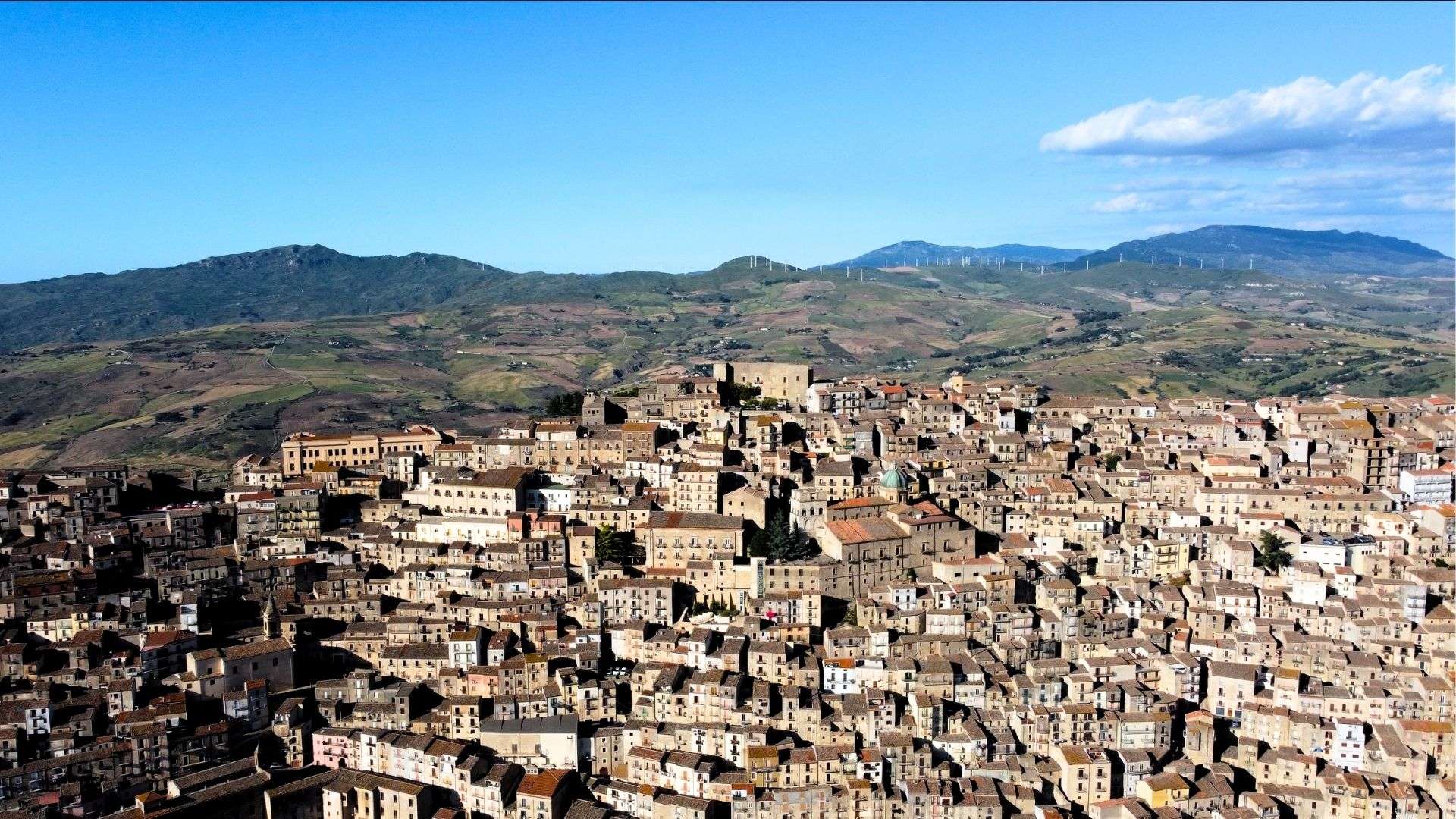
There’s a moment, driving along the roads that climb towards the Madonie, when the landscape opens up and the village profile suddenly appears along the ridge. The houses, pressed one against another, take on a warm tone that at sunset becomes almost honey-coloured. Seen from above, the urban layout draws a compact and surprising shape that many have compared to a turtle resting on the mountain.

It is not a narrative device, but the real morphology of Gangi, one of the highest centres of inland Sicily.
In recent years, the village has been cited in several travel publications and included in collections dedicated to lesser-known but more fascinating Italian places, also picked up by the international press, including the British newspaper The Guardian which in November 2025 published a reader’s tip describing Gangi as a stop on the Via dei Frati walk. The reason lies not only in its aesthetics, but in the coherence between landscape, history and identity.

The rite that crosses its streets

In Gangi, the most significant collective moment takes place on the Monday following Pentecost, on the occasion of the Feast of the Holy Spirit. It is a tradition documented for centuries and deeply rooted in the local community.
On that day, a solemn procession crosses the historic centre: numerous simulacra of saints and of the Madonna are carried on shoulders along the uphill alleys up to the Sanctuary of the Holy Spirit, located just outside the inhabited nucleus. The procession follows a precise order, linked to the confraternities and local tradition.

The culminating moment is the cursa di li Santi, when the statues are made to run symbolically in the square in front of the sanctuary as a gesture of devotion and thanksgiving. The intensity of the rite does not derive from scenic effects, but from widespread participation: families, bearers, confraternities and residents take part in the event according to consolidated customs.
In those days, the village does not appear as a historic centre restored for tourism, but as a space still crossed by collective practices that keep its social structure alive.

Architecture and stratification

Gangi’s urban layout is the result of a long historical stratification. The centre does not develop on a regular plane, but follows the mountain ridge faithfully. The houses share load-bearing walls and are arranged on different levels, creating a continuous building system that responded to defensive and climatic needs.

Verticality is not a scenic element, but a technical solution. Narrow streets protect from the wind, building density retains heat in the winter months, compactness reduced vulnerability. This balance between form and function is what still makes the original logic of the village readable today.

In the heart of the historic centre stands Palazzo Bongiorno, built in the 18th century during a period of economic consolidation. The interior frescoes and the monumentality of the rooms testify to a season in which the town participated in broader aristocratic and commercial networks. It is not an isolated building, but the tangible sign of a moment of social expansion.

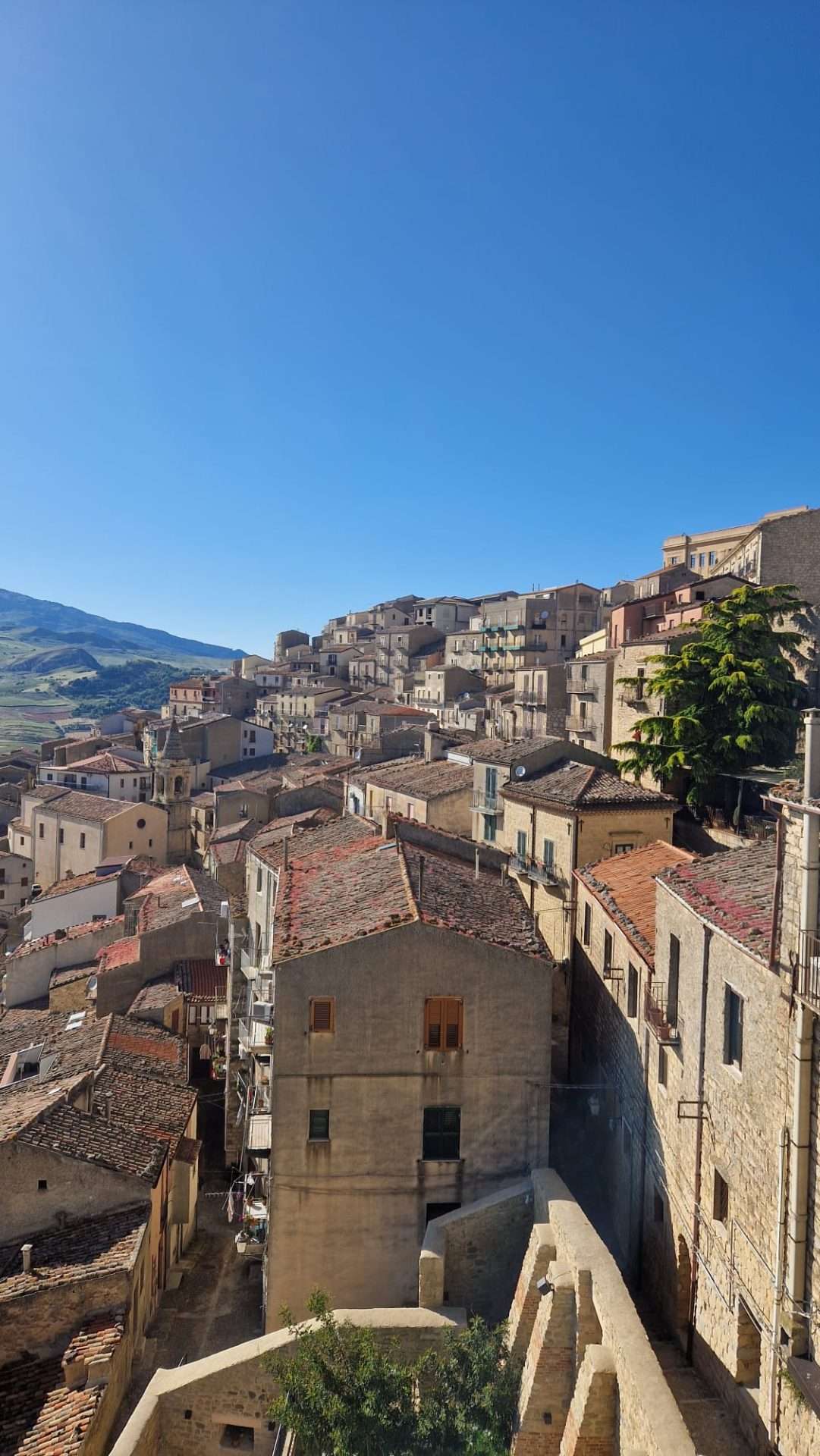
Rooftops of Gangi, Sicily, stepping down the slope with the Madonie hills behind
The village sits at 1,011 metres and steps down the ridge in bands: it is this layering that draws the turtle profile seen from above.
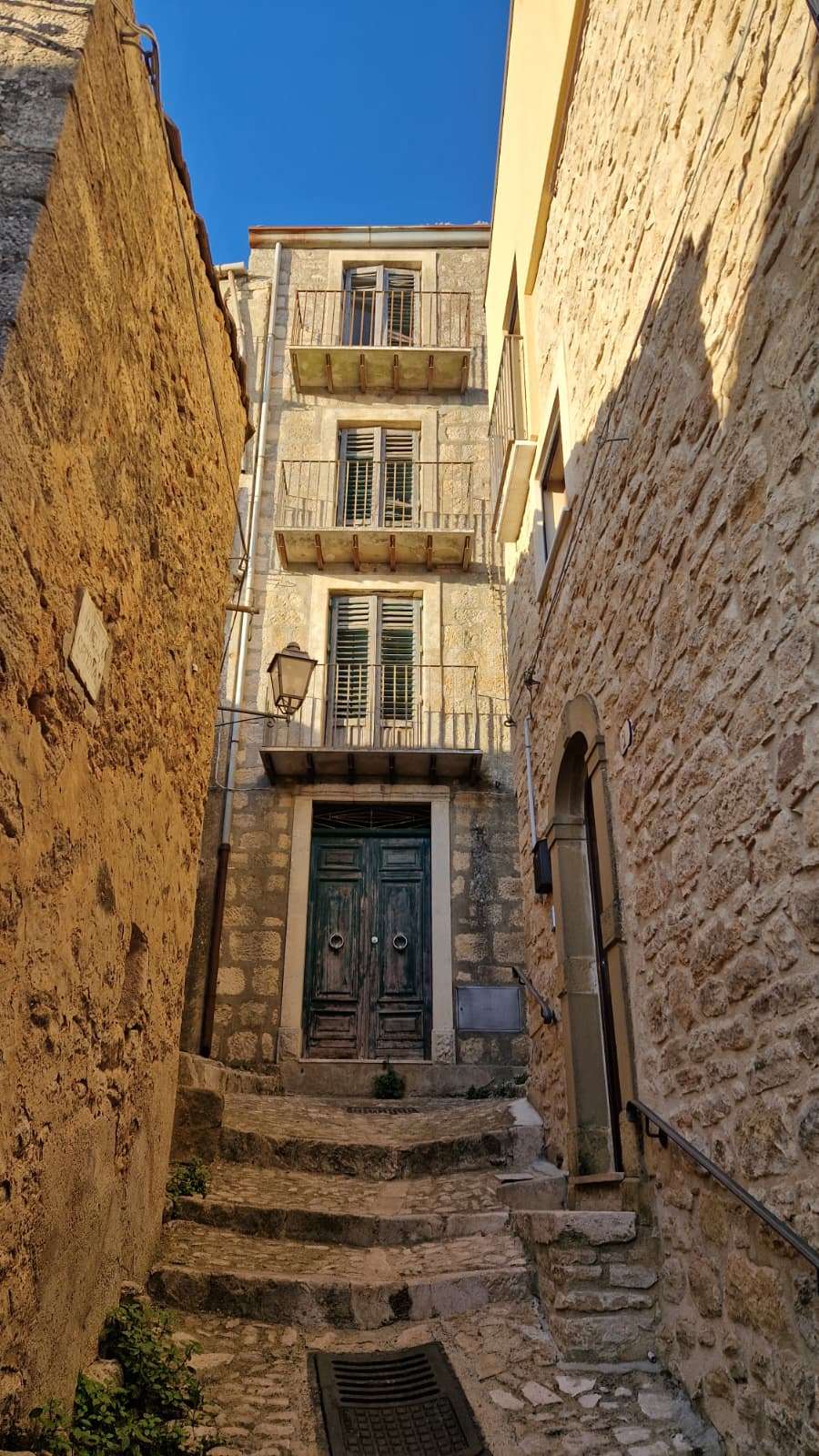
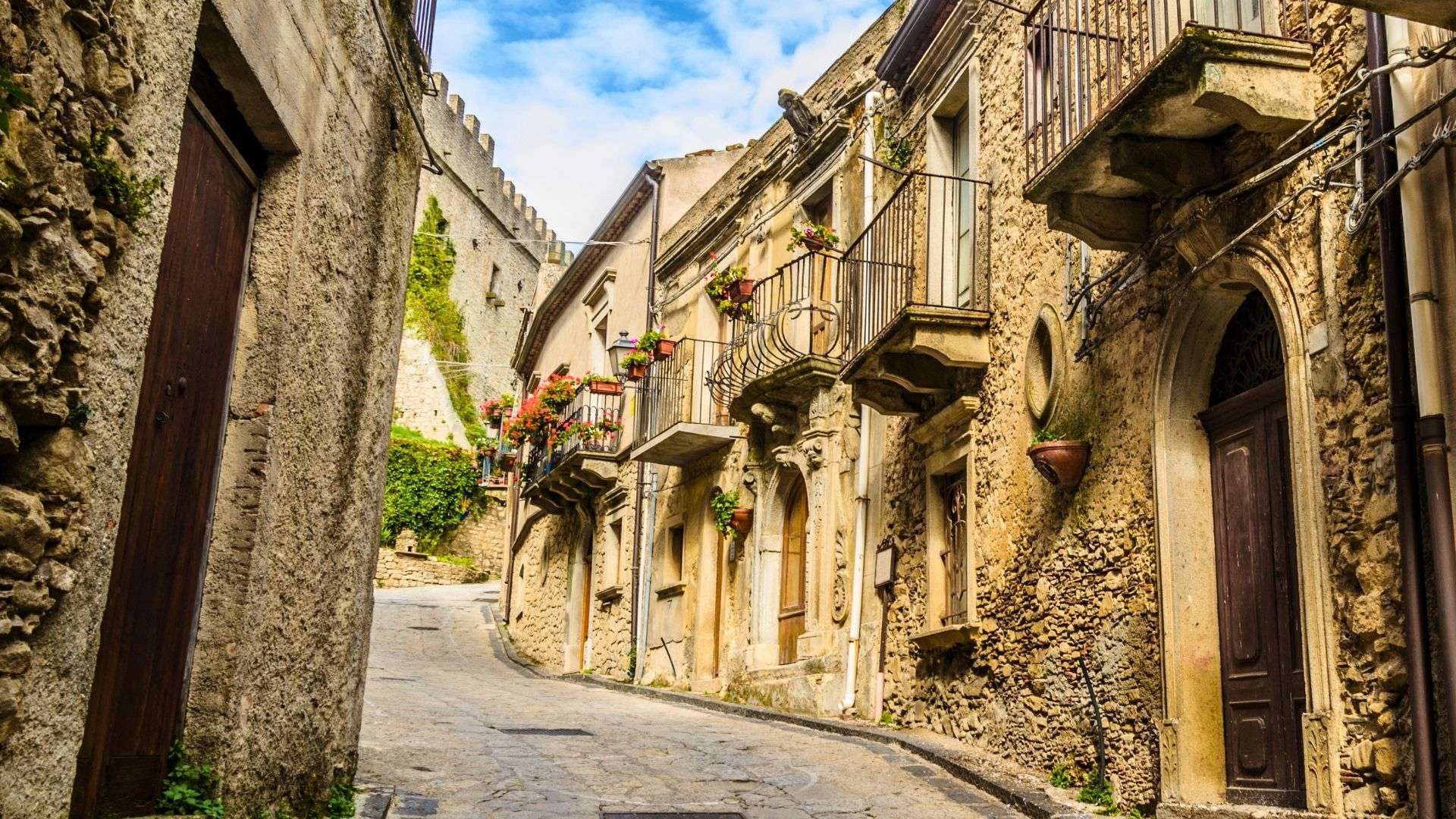
Stepped alley in Gangi leading to the weathered green wooden door of a stone palazzo, with a wrought-iron street lamp
The old town is built of stepped alleys: distances are short, but almost always uphill.

A few steps away, the Mother Church of San Nicolò reaffirms religious centrality in the urban structure. The position of the building, in dialogue with civic spaces, reflects a typical organisation of medieval villages, in which spiritual power and secular power coexisted in a balance visible in space.

Stratification can also be read in less evident details: carved portals, family coats of arms set into façades, loggias open towards the valley. No element appears foreign to the context. It is this continuity that distinguishes Gangi from centres reconstructed in an excessively scenic way.

From recognition to regeneration

In 2014, Gangi obtained the title of Borgo dei Borghi, an event that changed the national perception of the town and brought attention back to a centre that was facing a progressive demographic contraction. 

Alongside this visibility, there has been a policy of recovery of the building heritage, including participation in the initiatives of the so-called one-euro houses

The topic, often told in a superficial way, is more articulated than it seems and requires a careful assessment of urban planning and structural conditions. It is an aspect that returns frequently when analysing regeneration programmes in small Italian municipalities, as well as in the broader reflection on the opportunities offered by inland villages.
It is no coincidence that, in parallel, attention has been reignited towards municipalities in Southern Italy also in relation to certain facilitated tax regimes, such as the 7% regime for foreign pensioners
The debate on residence, taxation and inner areas inevitably intertwines with concrete examples such as Gangi.

Gangi beyond the iconic image

The aerial photograph that resembles a turtle has contributed to its recognisability. The mention in international collections, also picked up by The Guardian and other big names, has broadened the audience that has heard about it.

However, what distinguishes Gangi is not a single iconographic element, but the coherence between urban morphology, still-living rituality and the landscape context. It is a mountain centre that has crossed centuries without losing readability, and that today is being observed with a new gaze.

The mystery does not lie only in the processions that walk through its streets, but in the ability to maintain continuity between past and present without turning into a simple setting.
And perhaps it is precisely this continuity, more than the shape seen from a drone, that explains why a village in inland Sicily can appear, even from afar, surprisingly current.

Usefulness: how to get there, services, work

A mountain village is not chosen only for its aesthetics, but for what it allows in everyday life.

How to reach Gangi

Gangi is located in the heart of the Madonie, in inland Palermo province. The reference international airports are:

• Palermo Falcone–Borsellino (PMO)
• Catania Fontanarossa (CTA)

In both cases, travelling by car takes approximately between one hour and forty-five minutes and two hours, with the last stretch crossing the mountain plateau.
It is possible to arrive by combining train and bus, but the most functional solution remains the car, especially for those who intend to stay more than a few days or explore the Madonie area.

Healthcare and hospital facilities

In Gangi there are basic services: general practitioner, paediatrician, pharmacy and out-of-hours medical service for non-serious urgencies in the evening and holiday time slots.

For hospital emergencies or specialist services, you move instead towards larger facilities. The most used references are:

Fondazione Istituto G. Giglio, in Cefalù, with an emergency department active 24 hours a day;
Ospedale Madonna dell’Alto, in nearby Petralia Sottana;
• the hospital facilities in the Enna area, on the inland side.

The distance is not negligible, but it falls within the normality of Italian mountain municipalities. Those who are considering a prolonged stay or a stable transfer must include this element in their decision, especially if they come from urban contexts where hospital access is immediate.

Working remotely: a concrete sign

In recent years, a coworking space has been activated in the historic centre, as part of a broader process of updating public services in small municipalities. The initiative is part of the Madonie coworking network, designed for agile work, study and professional activities.

The interesting fact is not the opening itself, but what it implies: the possibility of maintaining professional continuity in a context until recently considered exclusively tourist or seasonal.
A village is fascinating for its architecture; it becomes truly liveable when it allows stable connection, shared spaces and sustainable daily organisation.

For those who work remotely and are considering Sicily as a temporary or stable base, the issue is not only the landscape, but the compatibility between visa, tax residence, healthcare coverage and digital infrastructure. It is an evaluation that requires method, especially when coming from abroad — as we explore in our pathway dedicated to digital nomads who choose Italy.

Aerial view of Gangi on its ridge, with the Madonie hills and a wind farm in the background

Gangi at a glance: what distances and what services?

If you are not just visiting but weighing up a move, here are the essentials at a glance.

ItemReferenceDistance / details
AirportPalermo Falcone-Borsellino (PMO)about 1 h 45 – 2 h by car
AirportCatania Fontanarossa (CTA)about 1 h 45 – 2 h by car
AltitudeMadonie ridge1,011 m above sea level
PopulationISTAT, 1 January 2026 (estimate)5,918 residents
Hospital with emergency roomFondazione Istituto G. Giglio, Cefalù24-hour emergency room
HospitalOspedale Madonna dell’Alto, Petralia Sottananearby
AwardBorgo dei Borghi (Rai 3)2014

Conclusion: who Gangi can truly be for

Gangi is not a universal choice. It can be coherent for those who seek a mountain context with readable historical identity, for those who accept car-based mobility, and for those who want a compact urban environment, free from disorderly expansions.
It can represent an interesting solution for those who work remotely and want to alternate urban periods with periods of concentration in a more contained context, on the condition of realistically assessing services, distances and infrastructure.

It is less suitable for those who need frequent airport connections, immediately accessible specialist hospital services, or an already structured international ecosystem.

The turtle shape seen from above remains the most immediate image. However, what truly defines Gangi is not only the compactness of its urban structure, but the way that structure continues to be inhabited.
In small centres, proximity is not an abstract concept. Short distances, uphill streets, compact squares foster inevitable daily relationships. The community is not a decorative element of the landscape: it is an integral part of the urban organism.
The confraternities that organise the Feast of the Holy Spirit, the families who have lived for generations in the same buildings, the new presences that gradually enter the existing fabric compose a fragile but real balance. It is not an anonymous context, nor a neutral one. It is a recognisable social space, where relationships have a specific weight.

Perhaps this is precisely what makes Gangi contemporary: the ability to maintain a sense of belonging in an age of continuous mobility. An urban structure can cross centuries; it is the community that allows it to remain readable.

Sources

Share on:

Frequently asked questions

Seen from above, the compact layout of the village along the ridge draws a shape many observers associate with a turtle resting on the mountain. It is not a design feature: it is the real morphology of the town, born of a long historical layering along the terrain.

On the Monday after Pentecost a procession documented for centuries crosses the old town: statues of saints and of the Madonna are carried on shoulders up to the Sanctuary of the Holy Spirit. The high point is the cursa di li Santi, when the statues are symbolically made to run in the square in front of the sanctuary.

Palazzo Bongiorno was built in the eighteenth century, during a phase of economic consolidation, and stands in the heart of the old town. Its interior frescoes and the scale of its rooms speak of a period when Gangi took part in aristocratic and commercial networks far wider than its own territory.

In 2014 Gangi won the title of Borgo dei Borghi, the Rai 3 television contest. The award changed how the village was perceived nationally and brought attention and restoration projects to a town that until then had been living with depopulation.

Gangi is reached by car from inland Palermo province. Palermo Falcone-Borsellino and Catania Fontanarossa airports are both about one hour and three quarters to two hours away. Public transport exists but is designed for local connections: without a car, daily life is complicated.

The village has the basic services: a general practitioner, a pharmacy and outpatient clinics. The nearest hospital is in Petralia Sottana; the 24-hour emergency room is at the Fondazione Istituto G. Giglio in Cefalù.

It depends on the kind of work. The cost of living and of property is low and the setting is quiet, but the distances from airports and large cities are those of a mountain village. It works for people who do not need to travel often.

DISCLAIMER

The information provided on this website is for general informational and illustrative purposes only. It does not constitute legal, tax, financial or professional advice and should not be relied upon as such.
While we strive to ensure the accuracy and timely updating of all content in accordance with current laws and regulations, we accept no responsibility for any errors, omissions, misinterpretations, or changes in legislation that may occur after publication. Any decisions or actions taken based on the information contained on this website are undertaken at the user’s sole risk.

Our services

Did you enjoy
this article?

Discover how we can help you relocate or invest in Italy with our dedicated services.

Tailored planning to live or invest in Italy.

Property purchase and management in Italy.

Relocation assistance for visas and residence permits.

Support for businesses and investors choosing Italy.

MAgazine

Stay up To Date!

Subscribe to our newsletter to stay up to date with the latest news.