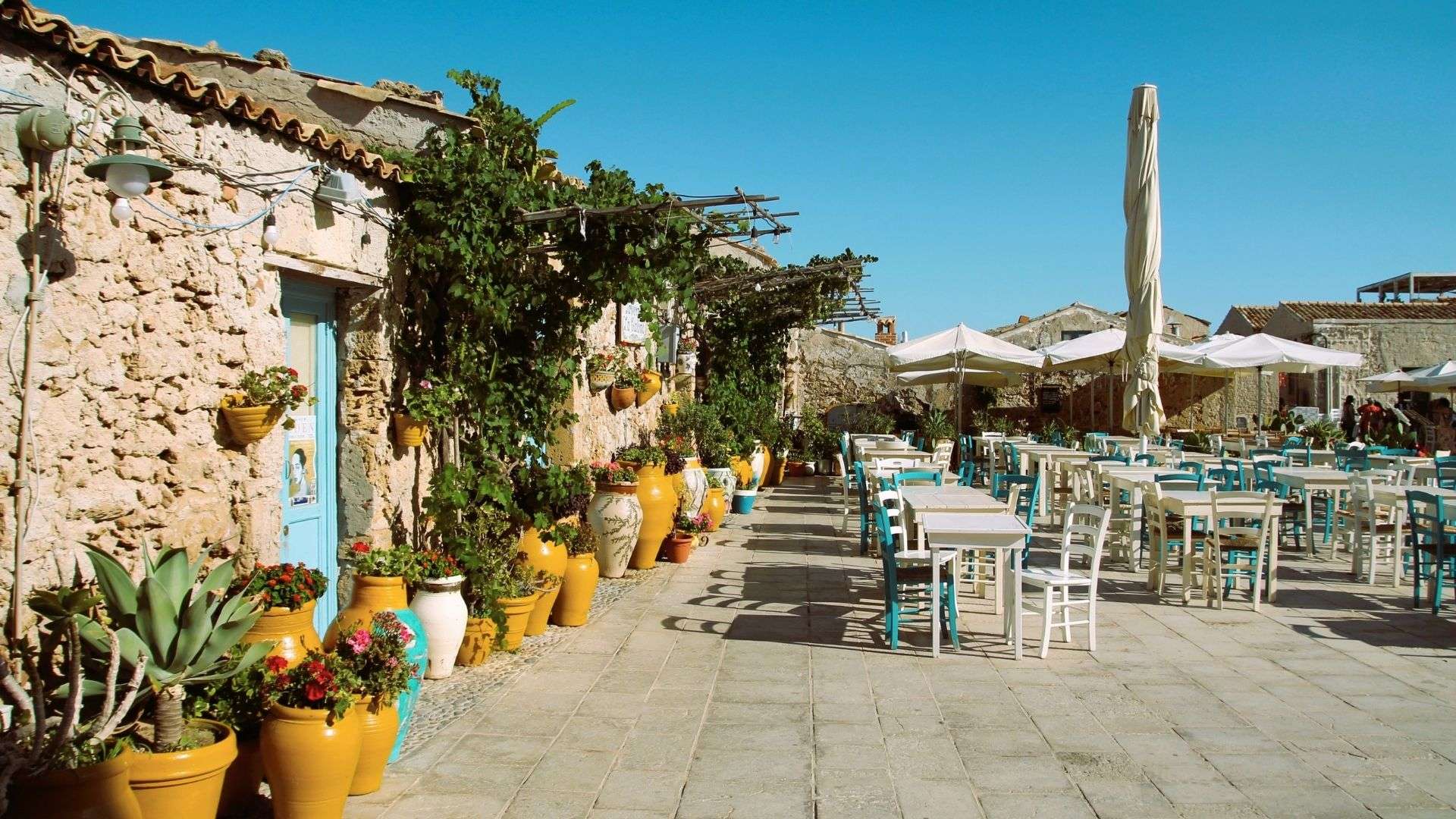
There is a reason Sicily attracts people who are done with dreaming and ready to act. It is not only the sea that changes colour three times a day, nor the stone villages where time seems to have stopped in the most generous way. It is that this island, in recent years, has stopped waiting for people to return and has decided to make the invitation concrete.
On 10 April 2026 the Sicilian Regional Council approved the implementing decree that makes operative a measure contained in the Regional Stability Law 2026-2028 (Regional Law no. 1 of 5 January 2026, art. 25): a non-repayable grant equal to 50% of the IRPEF income tax paid by those who transfer their residence from abroad to Sicily, purchase or renovate a property on the island and maintain the required conditions. 60% for those who choose a municipality with fewer than 5,000 inhabitants.
The measure has been described as “currently unique in Italy” — and that is not an overstatement. No other Italian region has ever introduced a direct, general reimbursement mechanism on personal income tax already paid, open to workers, self-employed, entrepreneurs and pensioners alike, without requiring specific qualifications or minimum asset thresholds. But this new measure sits within a broader framework of tax benefits in Sicily that, taken together, make the island one of Europe’s most competitive destinations for those arriving from abroad.
This guide covers all of them — accurately, without unjustified enthusiasm and without omitting the constraints that need to be understood before making a decision.
The 2026 news: a non-repayable grant worth 50% of income tax paid
How it works: a payback, not a discount
The first misconception to clear up is technical but fundamental, because many articles describe this incorrectly.
The Sicilian contribution is not a preventive discount on the IRPEF to be paid. It does not reduce withholding, does not lower the tax bracket, does not work as a deduction to be entered in a tax return. It is a retrospective reimbursement: first you pay the full IRPEF through the standard F24 payment form, then you submit a claim to the Region, which disburses the grant equal to 50% (or 60%) of the tax already paid.
The operative sequence is:
- Transfer residence to Sicily and establish tax domicile
- Purchase or renovate a property within 12 months
- File the tax return and pay IRPEF in the ordinary way
- Submit a reimbursement claim to the Region
- The Region disburses the non-repayable grant
This mechanism has a practical implication that should not be underestimated: the beneficiary must have the liquidity to pay the full tax before receiving the reimbursement. This is not an immediate cash advantage — it is a two-step financial flow that requires planning.
A technical point no secondary source mentions: the contribution is calculated on the share of IRPEF due to the Sicilian Region under art. 2 of Presidential Decree no. 1074 of 26 July 1965. Sicily, as a Region with Special Statute, collects its own share of the IRPEF paid by its residents — and it is on this regional share that the reimbursement is calculated, not on the full national IRPEF. The operative procedures — not yet published — will clarify this in the effective calculation.
The requirements: all cumulative, no exceptions
Art. 25 of Regional Law no. 1/2026 establishes that the contribution is available to those who satisfy all of the following conditions simultaneously.
a) Coming from abroad The transfer must be from abroad to a Sicilian municipality, with the establishment of tax domicile in Sicily between 1 January 2026 and 31 December 2028. The measure is triennial — not permanent.
b) Taxable income or pension The beneficiary must produce taxable income — from employment, self-employment or business activity — or hold a pension subject to Italian IRPEF. Being fiscally resident is not sufficient: an effective tax liability is needed to calculate the reimbursement.
c) Purchase or renovation of a property Within 12 months of establishing tax domicile, the beneficiary must purchase a habitable property located in Sicily, or carry out building works — excluding ordinary maintenance — on a property they already own in Sicily. Those who rent do not satisfy this requirement.
d) Maintenance of residence and property ownership This is the point that almost all commentators report incorrectly. Art. 25 does not require maintaining residence until 31 December of the following year — it requires maintenance until 31 December of the second year following the year of transfer. The same obligation applies to property ownership. Failure to comply triggers revocation of the contribution with an obligation to return the amounts already received.
| Year of transfer | Maintenance obligation until |
|---|---|
| 2026 | 31 December 2028 |
| 2027 | 31 December 2029 |
| 2028 | 31 December 2030 |
The numbers: what it is actually worth
| Scenario | Reimbursement | Annual cap | Maximum years of benefit |
|---|---|---|---|
| Any Sicilian municipality | 50% of IRPEF paid | €100.000 | 3 (only if transfer in 2026) |
| Municipality with fewer than 5,000 inhabitants | 60% of IRPEF paid | €100.000 | 3 (only if transfer in 2026) |
The time window is a strategic element. Those who transfer in 2026 receive all 3 years of benefit. Those who transfer in 2027 receive 2, those in 2028 only 1. The full three-year window closes on 31 December 2026.
Illustrative examples
1. Self-employed worker, taxable income €80,000 — standard municipality Estimated gross IRPEF (2026 brackets: 23% up to €28,000, 33% up to €50,000, 43% above): approximately €26,700. Reimbursement at 50%: ~€13,350/year, ~€40,050 over 3 years.
2. Self-employed worker, taxable income €80,000 — municipality under 5,000 inhabitants Reimbursement at 60%: ~€16,020/year, ~€48,060 over 3 years.
3. Pensioner, taxable income €55,000 — municipality under 5,000 inhabitants Estimated gross IRPEF: approximately €16,190. Reimbursement at 60%: ~€9,714/year, ~€29,142 over 3 years.
4. Couple, both with taxable income — municipality under 5,000 inhabitants The €100,000 annual cap applies per beneficiary individually — not per household. If both partners satisfy the requirements, the advantage multiplies.
*These figures are illustrative only: the effective amount must be verified against the individual case.
The other tax benefits for those moving to Sicily
The 50% income tax refund is the 2026 news. But those who choose Sicily from abroad can count on a broader framework of tax benefits, built over time by both the State and the Region. These are different instruments, with different requirements and different target profiles — and they cannot be combined with each other. Understanding all of them is the first step to identifying which one fits your situation.
The 7% flat tax for retirees with foreign income (art. 24-ter TUIR)
Introduced in 2019 and updated by Law 34/2026, this regime allows holders of a foreign-source pension who transfer to southern Italian municipalities with fewer than 30,000 inhabitants to pay a 7% substitute tax on all foreign-source income — not just the pension, but also dividends, capital gains, rental income and foreign returns — for 9 consecutive tax periods. No property purchase required, no qualifications needed: you simply need not to have been a tax resident in Italy in the previous 5 years and to choose an eligible municipality. Sicily, with its villages in the Madonie, Nebrodi, Val di Noto and inland areas, offers hundreds of options
Are you considering moving to Italy as a retiree? Discover our "Silver Move" program.
The impatriates regime for qualified workers (art. 5, D.Lgs. 209/2023)
For those who transfer tax residence to Italy after at least 3 years abroad and meet the requirement of high qualification or specialisation (D.Lgs. 108/2012), the impatriates regime reduces by 50% the IRPEF taxable base on employment and self-employment income for 5 years, with a cap of €600,000. If you relocate with dependent minor children, the exemption rises to 60%. No property purchase required. It also applies to those working remotely for a foreign employer, provided the activity is carried out predominantly from Italian territory (Revenue Agency Ruling no. 2/2026).
Are you considering moving to Italy as a digital nomad?
We have the right solution for you!
The neo-residents flat tax for significant assets
The neo-residents flat tax for significant assets (art. 24-bis TUIR) For those who transfer their tax residence to Italy without having been resident there for at least 9 of the previous 10 years, Budget Law 2026 (Law 199/2025) provides a fixed substitute tax of €300,000 per year on all foreign-source income, regardless of the amount, for a maximum of 15 years. It includes exemption from foreign asset monitoring (quadro RW, IVAFE and IVIE). This is the instrument designed for those with significant foreign income seeking long-term fiscal stability.
Are you planning to move to Italy as an HNWI?
Discover "Elite Residency," our tailored pathway for high-net-worth individuals.
These three regimes and the 50% IRPEF reimbursement cannot be combined: art. 25, paragraph 3 of Regional Law no. 1/2026 explicitly excludes the cumulation with any other tax incentive for attracting new residents. But this is not a limitation — it is an invitation to choose the instrument that best fits your profile.
Which tax regime should you choose if you move to Sicily
The table below lists exclusively the regimes concretely operative and accessible today.
| Profile | Optimal regime | Why |
|---|---|---|
| Worker/professional with impatriates requirements (high qualification, 3+ years abroad) | Impatriates regime | 50% exemption for 5 years outperforms the Sicilian reimbursement on a five-year basis in most cases |
| Worker/self-employed without impatriates requirements | Sicily IRPEF reimbursement 50-60% | It is the only incentive accessible without specific qualifications |
| Retiree with foreign pension, municipality under 30,000 inhabitants | 7% regime | 7% on all foreign income for 10 years is generally more advantageous than the 50% reimbursement for 3 years |
| Retiree with foreign pension, municipality under 5,000 inhabitants, short horizon | Case by case | The 60% for 3 years may be comparable to the 7% over a short horizon; depends on income structure |
| Italian AIRE retiree with Italian INPS pension | Sicily IRPEF reimbursement 50-60% | The 7% regime requires a foreign-source pension and is not accessible; the Sicilian reimbursement is the only available option for this profile |
| HNWI with significant foreign income | Neo-residents flat tax | €300,000/year on unlimited foreign income for 15 years is not comparable to the three-year reimbursement |
A note on the Italian AIRE pensioner profile deserves specific attention. Unlike the 7% regime, which expressly requires a foreign-source pension (art. 24-ter TUIR), art. 25 of Regional Law no. 1/2026 refers simply to a “pension” without specifying its source. On the literal reading of the text, an Italian registered with AIRE holding an INPS pension who returns to Sicily, purchases a property and satisfies the other requirements appears to fall within the eligible group. This is also consistent with the declared intent of the measure, which explicitly cited “emigrants, and in particular young people, who want to come back to live on the island” among its targets. Official confirmation is expected with the operative procedures.
The property requirement: purchase, renovation and €1 houses
The regulation provides two paths for the property requirement.
Purchase: the property must be habitable. No typological restrictions apply: new builds, resales, properties from judicial auctions and €1 houses all qualify — provided the purchase takes place within 12 months of establishing tax domicile and the property is (or is made) habitable. Mussomeli, Gangi, Sambuca di Sicilia, Salemi, Troina: these are Sicilian municipalities with active programmes of symbolic-price sales, many of them under 5,000 inhabitants — which means access to the 60% reimbursement rather than 50%. An opportunity that multiplies: a symbolic-price property, renovation costs, and recovery of 60% of IRPEF for three years.
Building works on an already-owned property: this is the path for those who already own a property in Sicily and wish to renovate it. Ordinary maintenance is explicitly excluded — works must qualify as renovation, conservative restoration or structural refurbishment under Presidential Decree no. 380/2001.
The deadline is 12 months from the date of establishing tax domicile — not from arrival in Italy, not from anagraphic residence registration. A relevant technical distinction for those planning a gradual relocation.
Explore our in-depth guides on one-euro homes
The bigger picture: Sicily is building something
The income tax reimbursement is not an isolated measure. It sits within a broader legislative package contained in the same Regional Stability Law 2026-2028 (Regional Law no. 1/2026):
Sicilian decontribution (art. 1): non-repayable grant of up to 15% of labour costs for new permanent hires by companies based in Sicily. The contribution rises to 15% for companies that introduce employee welfare schemes, reduce working hours to 35 per week, or hire women and workers over 50.
Sicily Working (art. 3): grant of up to €30,000 for European companies hiring workers in smart working from Sicily, with funding for coworking spaces in disused public and religious buildings.
Building incentives (art. 5): non-repayable grants for energy efficiency and seismic upgrading of existing residential buildings.
In parallel, the 7% regime updated by Law 34/2026 continues to make Sicily — with its villages under 30,000 inhabitants, the baroque towns of the Val di Noto, the minor islands, the Madonie and Nebrodi highlands — one of the most fiscally competitive destinations in Europe for retirees with foreign income.
And then there are the €1 houses. Mussomeli has made its platform permanent with over 200 completed sales. Gangi, in the Madonie mountains, is the village that started the phenomenon, with hundreds of new residents — Italian and foreign — who chose to build something among those ancient stones. Sambuca di Sicilia has attracted residents from dozens of countries, creating a small international community that works remotely between vineyards and rolling hills.
All of this is not a system of incentives in the technical sense. It is an argument. Sicily is not just offering tax discounts — it is building the conditions for living here to become a rational choice, before it becomes an emotional one.
Some wonderful places in Italy to consider for your move
A pending proposal: the 4% bill for those with an Italian pension
This section concerns a legislative proposal not yet approved. It produces no effects today and should not be included in any relocation plan as an available measure.
Those who receive a pension paid by an Italian social security institution — INPS, professional funds, sector-specific schemes — and have lived outside the European Union for at least 5 years find themselves today in a precise regulatory gap. The 7% regime requires a foreign-source pension: those who worked in Italy and accumulated INPS contributions cannot access it. The neo-residents flat tax requires €300,000/year in substitute tax. The impatriates regime is reserved for active workers. The Sicilian IRPEF reimbursement partially fills this space — but is limited to 3 years and to those who choose Sicily.
This is not exclusively a matter for Italian nationals registered with AIRE. It concerns anyone who built up pension contributions in Italy and then emigrated: an Italian who worked thirty years in Rome and now lives in Sydney, but equally an Argentine who worked in Milan for twenty years and receives an INPS pension, or a Canadian who paid into the Italian system in the 1980s before returning home. An Italian pension is the common thread — not nationality.
In the Senate, Bill S. 1495 (Matera-Fallucchi, Brothers of Italy), filed in May 2025, is under discussion. It introduces a new art. 24-quater in the TUIR: a substitute IRPEF rate of 4% on all income not already taxed in Italy — including the INPS pension — for 15 years, for those who transfer from non-EU countries to SNAI inner-area municipalities with fewer than 3,000 inhabitants. The Senate Social Affairs Committee expressed a favourable opinion on 10 March 2026; the parliamentary process is continuing in the Finance Committee.
The bill is not yet law. If approved, it would fill a gap that currently leaves without any national incentive an entire category of people who contributed to the Italian pension system — and who might choose Italy, and Sicily, as their destination.
What is still missing: the application process
The implementing decree is approved. The regulation is in force. Those who transfer their residence today satisfy the requirements and will be able to submit the reimbursement claim when the operative procedures are available.
However, as of the time of writing (April 2026) the Sicilian Region has not yet published the access portal, application forms, submission deadlines or required documentation. This step is expected shortly.
Impatria will update this guide as soon as the procedures become available. For those who want a preliminary assessment of their specific situation today — including income structure, compatibility with other regimes, choice of municipality, and property purchase plan — our pathway includes this analysis in the pre-feasibility phase, before any definitive decision is made
Do you need an initial consultation to assess whether your move to Italy is feasible? Explore all our services
Conclusion: not for everyone, but for those who are ready
The 50% income tax reimbursement is not a tool for fiscal optimisation without genuine commitment. The property requirement is mandatory. The obligation to maintain residence and property ownership runs until 31 December of the second year following the transfer. The mechanism is a payback — not an immediate advantage at signing.
For those with a genuine intention — to actually move, buy a home, build something in Sicily — the measure adds a solid economic argument to a choice that was already rational on other grounds. For the self-employed worker without the qualifications for the impatriates regime, it is the only concrete incentive available today. For the Italian AIRE pensioner with an INPS pension, it would be the first fiscal measure to genuinely support their return. For those who want to purchase in a village under 5,000 inhabitants — perhaps one of the €1 houses in the Madonie or the Nisseno area — the 60% reimbursement over three years changes the numbers of the project in a meaningful way.
Sicily has never had so many reasons to be chosen.
Primary sources
- Regional Law of Sicily no. 1 of 5 January 2026, art. 25 — GURS Supplementary Ordinary no. 2 of 9 January 2026
- Implementing decree — Sicilian Regional Council resolution of 10 April 2026
- Official communication Regione Siciliana
- Presidential Decree no. 1074 of 26 July 1965 (IRPEF distribution — Regions with Special Statute)
Share on:
Faq
The currently operative benefits are four: the 50-60% IRPEF reimbursement (art. 25 Regional Law no. 1/2026, implementing decree of 10 April 2026), the 7% flat tax for retirees with foreign income (art. 24-ter TUIR), the impatriates regime for qualified workers (art. 5 D.Lgs. 209/2023) and the neo-residents flat tax of €300,000/year (art. 24-bis TUIR). They cannot be combined: each profile must identify the most advantageous regime for its own situation.
Individuals who transfer anagraphic residence and tax domicile from abroad to a Sicilian municipality between 1 January 2026 and 31 December 2028, produce taxable income in Italy (employment, self-employment or business activity) or receive a pension subject to Italian IRPEF, and purchase a habitable property or carry out building works on a property they already own in Sicily within 12 months of establishing tax domicile
On the literal reading of the regulation, and in the absence of other specifications, it appears so. Art. 25 requires being a "pension holder" without specifying that it must be a foreign-source pension — unlike the national 7% regime which expressly requires this. This is one of the points on which official clarification is awaited in the operative procedures.
No. Art. 25, paragraph 3 of Regional Law no. 1/2026 excludes cumulation with any other state or regional tax incentive for attracting new residents. Those with access to the impatriates regime or the 7% regime must choose.
Anagraphic residence, tax domicile and property ownership must be maintained until 31 December of the second year following the year of transfer — not the first. A transfer in 2026 creates an obligation until 31 December 2028. Non-compliance triggers revocation with an obligation to return the amounts received.
Yes. The property requirement is mandatory without exception. As an alternative to purchase, it is possible to renovate a property already owned in Sicily (with works that exclude ordinary maintenance), within 12 months of establishing tax domicile. Those who rent do not access the contribution.
Yes, if the purchase takes place within 12 months of establishing tax domicile and the property is habitable. Many Sicilian municipalities with symbolic-price sale programmes have fewer than 5,000 inhabitants, giving access to the 60% reimbursement.
The standard reimbursement is 50%. It rises to 60% for those who transfer to a municipality with fewer than 5,000 inhabitants. The €100,000 annual cap applies in both cases, per individual beneficiary.
Yes. The regulation requires maintaining property ownership until 31 December of the second year following the transfer, on pain of revocation and return of the amounts received.