
There is a type of property in southern Italy that cannot be imitated, built from scratch, or replicated elsewhere. The masseria — the great fortified farmhouse that has dominated the Puglian countryside for centuries — was not born as a luxury home. It was born as a response to fear.
Perimeter walls three metres high, a watchtower, a single gate crowned with arrow slits: the structure of a masseria records the history of a territory where farmers protected themselves from North African pirates, bandits and feudal raids with the same logic we use to install alarm systems today. That history is inscribed in Puglian limestone. No construction site can ever reproduce it. This is also why the market for historic masserie is structurally scarce — and structurally appreciating.
What is a masseria: history, architecture, identity
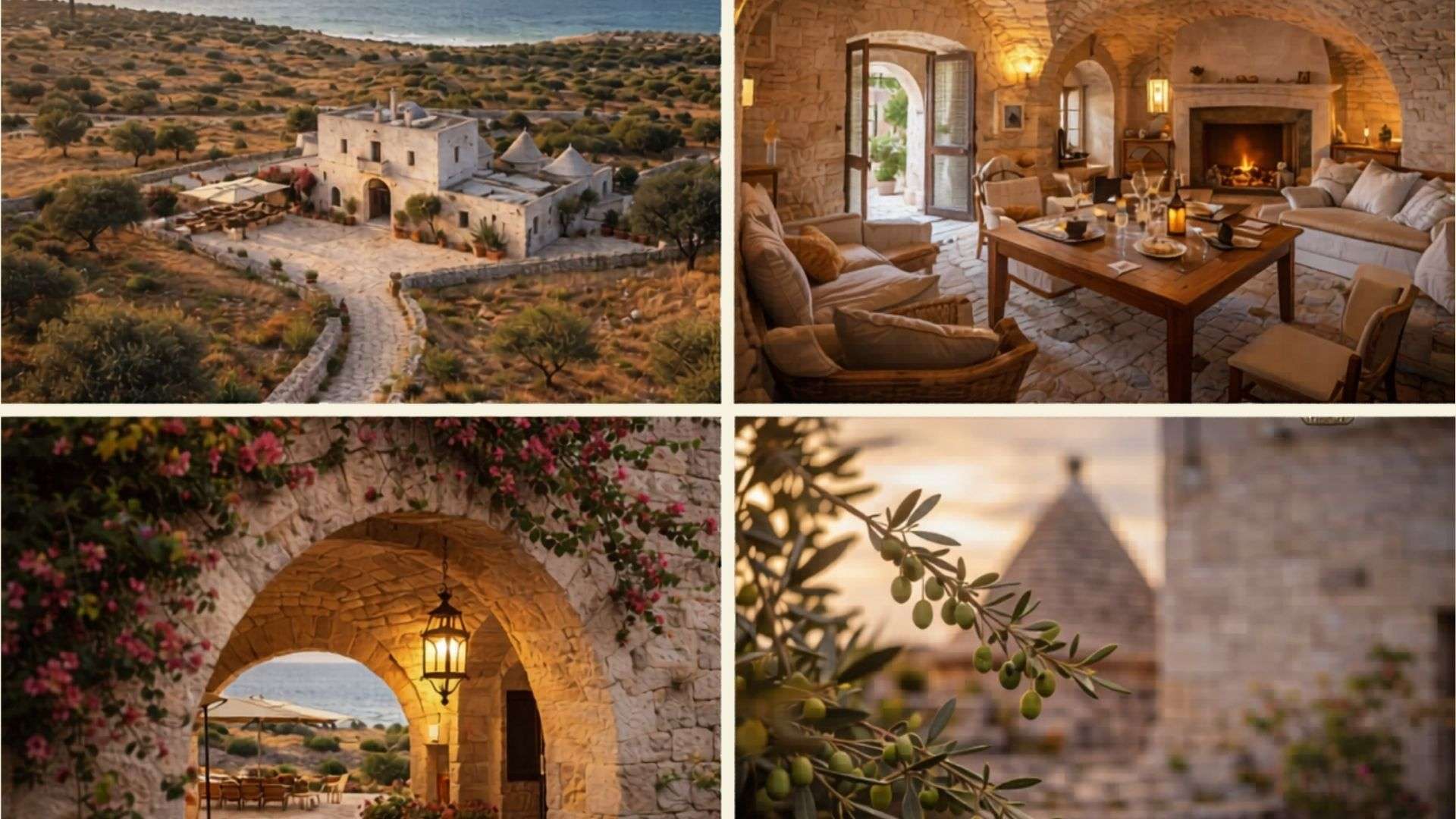
The term derives from the Latin massa, meaning a tract of cultivated land. In Puglia, between the fifteenth and seventeenth centuries, these agricultural estates gradually evolved into defensive systems: perimeter walls, corner towers, water cisterns, private chapels, underground oil mills carved into the limestone bedrock. The objective was to guarantee the survival of an entire community in the event of a raid.
The typical layout develops around an internal courtyard — the jazzo — onto which face the steward’s residence, the storage rooms, the stables, and the seasonal workers’ quarters. The massaro was the steward of the latifondo: not the owner, but the de facto manager of an aristocratic proprietor who rarely set foot in the countryside. The building takes its name from this figure.
The underground oil mill, excavated to exploit the constant temperature of the rock, allowed olive processing to continue uninterrupted through the winter months. In some masserie in the Salento and the Valle d’Itria these structures have remained intact for four centuries. This material continuity is what makes masserie genuinely unique market objects. Buying a masseria is not buying a house with old walls: it is entering into a relationship with a territorial heritage that Puglia considers part of its collective identity.
At a glance —A historic Puglian masseria is an irreproducible asset, subject to specific purchase rules (including agricultural pre-emption rights on the land) and heritage restrictions that condition restoration works. Foreign buyers can purchase if their country has a reciprocity agreement with Italy — which applies to the USA, UK, Australia, Canada and the vast majority of countries from which international masseria buyers originate. Italy's 7% flat tax regime for foreign-pension holders, updated from 7 April 2026 to cover municipalities up to 30,000 inhabitants, makes Puglia even more competitive for those wishing to transfer their fiscal residence here.
The market in 2026: international demand, constrained supply
The Puglian masseria market has one fundamental structural characteristic: quality supply is scarce and does not grow. Historic masserie are a fixed stock — new ones are not being built, and existing ones rarely come to market. This creates a situation in which growing international demand meets supply that cannot expand.
Over the past two years, international demand has intensified for converging reasons. British buyers are seeking alternatives following the abolition of the non-domiciled (non-dom) regime in 2024, and find in Italy’s 7% regime and new-residents flat tax a structured fiscal answer. American buyers — often with Puglian roots, but not exclusively — view Puglia as Tuscany twenty years ago: authentic, not yet inflated, still accessible. German, Dutch and Scandinavian buyers complete the picture.
The three main zones of concentration are the Valle d’Itria — the Ostuni-Alberobello-Locorotondo triangle — Puglia’s most internationally established zone, with trulli, dry-stone walls and views over the Adriatic; the Salento — Lecce, Otranto, Gallipoli — which has seen sustained growth over the past decade; and the Adriatic coast around Polignano a Mare, Monopoli and Fasano, perhaps the most sought-after for its combination of sea and countryside. The hinterland of Taranto and the Capitanata offer lower prices for those seeking large agricultural tracts and a more ambitious transformation project.
Quality properties almost never appear on major real estate portals. They circulate through local networks of agents, notaries and word of mouth. Having a reliable local contact — or a structured property finding service — often makes the difference between finding the right property and finding what is left on the market after informed buyers have already chosen.
Who can buy: rules for foreign nationals
EU citizens purchase property in Italy under the same rules as Italian nationals, without restrictions. For non-EU nationals the principle of reciprocity applies: Italy permits foreigners to buy property only if their country grants equivalent rights to Italians. For the vast majority of countries from which international masseria buyers originate — the United States, the United Kingdom, Australia, Canada, Switzerland — reciprocity is recognised. The notary verifies the current situation on a case-by-case basis in the deed.
Two practical prerequisites apply to everyone regardless of nationality: an Italian tax code (codice fiscale) — obtainable within a few days from any Italian consulate abroad — and an Italian bank account, required for notarial payments and utilities. A full procedural guide is available in the article on how to buy a house in Italy from abroad.
Important: property ownership does not automatically confer the right of residence. Buying a masseria is a patrimonial act that does not equate to a residency permit. Those wishing to relocate permanently must apply for the appropriate visa for their profile separately and in advance.
Due diligence: four checks that no guide mentions
The difference between a straightforward purchase and a problematic one almost always comes down to the due diligence phase, before the preliminary contract. Historic masserie present four categories of risk that foreign buyers systematically underestimate.
Heritage and landscape restrictions
Almost all historic masserie fall within areas subject to landscape constraints under Italy’s Cultural Heritage and Landscape Code (Legislative Decree 42/2004), and many are directly listed as cultural assets. Any structural intervention — extensions, modification of openings, roof reconstruction — requires authorisation from the Soprintendenza (Heritage Superintendence), which may prescribe specific materials, construction techniques and design solutions. The procedure is slower and more complex than a standard building permit: 6-18 months for significant works is not unusual. Verifying the presence and extent of constraints is the first operation to carry out, before making any offer.
Historic planning and cadastral irregularities
Masserie have been extended, modified and subdivided over centuries, often without every intervention being formally registered. Post-war additions, porticoes converted to enclosed rooms, storage spaces carved from previously open areas: planning and cadastral irregularities are the rule, not the exception. Before the preliminary contract, a professional floor-plan survey and a planning compliance check at the competent Municipality are essential. Irregularities that cannot be regularised, if discovered after the deed is signed, fall to the buyer.
Agricultural pre-emption rights on the land
Almost all masserie include land classified as agricultural. This activates the right of agricultural pre-emption under Article 8 of Law 590/1965 and Article 7 of Law 817/1971. In brief: if the land is subject to a tenancy agreement with a coltivatore diretto (direct farmer), that farmer has the right to purchase the property on the same terms offered to the foreign buyer. In the absence of a tenant, the right passes to neighbouring landowners who are direct farmers or professional agricultural entrepreneurs (IAP), provided they have been personally farming their land for at least two years and meet other qualifying conditions.
The mechanism works as follows: the seller must serve notice of the intended sale by registered letter. The person with pre-emption rights has 30 days to exercise the right. If the seller fails to serve notice, the holder of the pre-emption right may exercise the right of redemption within one year of the deed being registered — that is, they may step into the buyer’s position even after the deed has been signed, displacing them from ownership at the same price.
Practical implication for the foreign buyer
Before the preliminary contract: verify whether the land is subject to an active agricultural lease or whether there are neighbouring direct farmers. If rights-holders exist, the notary must serve formal notice, adding several weeks to the process. This is not an insurmountable obstacle, but overlooking it can cost the purchase.
Rural connectivity
Those buying a masseria with the intention of working remotely or using it as a primary residence need to know that fibre broadband coverage in Puglian countryside is still highly uneven. Urban centres and their peripheries are generally well served; isolated masserie in deep rural areas may only have access to ADSL or 4G/5G mobile data, with variable speed and reliability. Before purchasing, verify actual coverage — not the projected rollout targets — with a physical check during a visit to the property.
The purchase process: from preliminary contract to deed
The preliminary contract (compromesso) fixes the price, payment terms and deed date. The deposit (caparra confirmatoria) — typically 10-20% of the agreed price — is paid at this stage. Including suspensive conditions is strongly recommended: the purchase is conditional on satisfactory planning checks and on the absence of outstanding pre-emption rights. A preliminary contract without these protections exposes the buyer to losing the deposit if problems emerge.
The notary drafts the definitive deed and is legally impartial: they represent neither buyer nor seller. For this reason it is advisable for the foreign buyer to be assisted by their own legal adviser throughout the process. If the buyer does not speak Italian, Italian law requires the presence of a certified interpreter at the deed signing. This is not a formality: its absence can render the deed voidable.
Are you looking for assistance with relocating or buying a property in Italy? Discover all of Impatria’s services.

The tax structure: land vs building
The taxation of a masseria is complex because the deed typically covers two distinct asset categories: the rural building and the agricultural land. Taxes apply differently to each, and the buyer’s status materially affects the liability.
| Asset type | Non-farmer private buyer | Notes |
|---|---|---|
| Rural building (masseria) | 9% registration tax on declared value | + fixed mortgage and cadastral taxes |
| Agricultural land | 15% registration tax on declared price | + fixed mortgage and cadastral taxes (€50 each) |
| Total acquisition costs est. | 10–15% of total price | Depends on asset composition |
Regulatory data verified against Agenzia delle Entrate and notarial sources as of April 2026. Always verify with the appointed notary before signing.
Where building and land are sold together as a functional unit, the tax classification depends on which component carries predominant value. The notary defines the applicable regime in the deed based on cadastral and planning documentation.
Renovation: what to expect
Restoring a historic masseria is demanding on three fronts: regulatory, technical and financial. On the regulatory side, works on listed structures require Soprintendenza authorisation before the municipality issues a building permit. On the technical side, masserie present specific challenges: rising damp in stone walls, shallow foundations, lamia or trullo roof systems, and plant installations that must often be built from scratch.
Engaging local technicians with specific masseria experience — not generic builders — is the single most important choice a foreign buyer can make in the restoration phase. Costs vary enormously depending on the state of conservation, surface area and finish level. A realistic budget can only be obtained following an on-site survey by a local geometra or architect, after the constraints have been verified.
The masseria as investment: short-term rentals, agriturismo and return
A masseria with a pool in a prime Valle d’Itria or Salento location is one of the best-performing short-term rental assets in southern Italy. Peak season (July-August) delivers high occupancy at strong nightly rates; the spring and autumn shoulders are growing year on year, driven by European experiential tourism demand.
The agriturismo model is a distinct option: it requires registration with the regional agriturismo registry and the obligation that agricultural activity remains the primary activity relative to hospitality. The national reference framework is Law 96/2006; Puglia’s regional legislation is Regional Law 21/1996 and amendments. It makes sense where the masseria has genuine agricultural production (oil, wine, vegetables) to valorise alongside hospitality.
Short-term rentals are subject to a 21% flat tax for the first property and 26% from the second onwards (2024 and 2026 Budget Laws). The National Identification Code (CIN) has been mandatory since November 2024 (Law 191/2023). For a detailed guide on the returns and tax structure of Italian real estate investments, the reference article is on property investment in Italy from abroad.
Impatria helps you find quality masserie in Puglia that aren’t listed on property portals.
Discover our “property finder” service.

Tax incentives for those relocating: the 7% regime in Puglia in 2026
For those purchasing a masseria with the intention of transferring their fiscal residence here, Puglia became even more attractive following the regulatory update of 7 April 2026. Law 34/2026 expanded the population threshold for municipalities eligible under the 7% regime for foreign pension holders (art. 24-ter TUIR) from 20,000 to 30,000 inhabitants. This opens the incentive to many mid-sized Puglian municipalities that were previously excluded: towns such as Fasano, Nardò, Manduria and many others.
The regime allows holders of a foreign-source pension who transfer their fiscal residence to a qualifying municipality to pay a 7% substitute tax on all foreign-source income for up to 9 tax periods. Key conditions: no Italian fiscal residence in any of the 5 preceding tax periods; pension must be of foreign source; the originating country must permit information exchange with Italy.
Where to look: Puglia's zones by buyer profile
| Zone | Characteristic | Ideal buyer profile |
|---|---|---|
| Valle d'Itria (Ostuni, Locorotondo, Alberobello) | Highest concentration of historic masserie, established international demand, premium pricing | Luxury second home, premium Buy to Let, permanent residence |
| Adriatic coast (Polignano, Monopoli, Fasano) | Sea proximity, mature market, strong seasonal rental demand | Summer second home, short-term rentals, balanced investment |
| Salento (Lecce, Otranto, Gallipoli) | Strong recent growth, baroque architecture, expanding international tourism | Expat primary residence, mid-range investment, agriturismo |
| Hinterland and Capitanata | More accessible pricing, large land parcels, lower tourist pressure | Agriturismo project, agricultural lifestyle, long-term investment |
Conclusion
Buying a masseria in Puglia is not an ordinary real estate transaction. It is a project that requires preparation, patience, and the understanding that behind every limestone wall there are layers of legal history as well as architectural ones. Agricultural pre-emption rights, Soprintendenza constraints, cadastral irregularities accumulated over centuries: these are real variables, not abstract bureaucratic obstacles. Those who understand them in advance transform a potential risk into a manageable phase of the process.
The Puglian masseria market has a quality that figures alone do not convey: the best properties do not wait. They move through local networks, trusted notaries and word of mouth — and buyers who arrive with documentation already in order, a codice fiscale already obtained, and a clear picture of their fiscal profile hold a structural advantage over those who begin gathering information after finding the house.
Puglia in 2026 is no longer a niche destination. It is a region that has built a genuine infrastructure for international buyers, updated its fiscal instruments — with the expansion of the 7% regime to municipalities up to 30,000 inhabitants entering into force this year — and retained an authenticity that more heavily touristed regions have partly lost. For those willing to do the necessary groundwork, it remains one of the most compelling opportunities in the European property market.
Share on:
Faq
Yes, if their country has a reciprocity agreement with Italy. For citizens of the USA, UK, Australia, Canada and Switzerland, reciprocity is recognised. The notary verifies the current position in the deed. Property ownership does not automatically grant residence rights.
If the masseria includes agricultural land — which is almost always the case — the tenant direct farmer (if any), or in their absence the neighbouring direct farmers or professional agricultural entrepreneurs (IAP) under Law 590/1965, Art. 8 and Law 817/1971, Art. 7, have the right to purchase on the same terms offered to the foreign buyer. They have 30 days to exercise the right from formal notice. If the seller omits to serve notice, the rights-holder can exercise the right of redemption within one year of the deed being registered, displacing the buyer even after the deed is signed.
Almost always yes. Historic masserie fall within areas subject to landscape constraints (Legislative Decree 42/2004) and many are directly listed as cultural assets. Structural works require Soprintendenza authorisation. Materials, construction techniques and volumes may be prescribed. This is a process that must be planned well in advance with experienced local technicians.
For a private foreign buyer not qualified as a direct farmer: 9% registration tax on the value of the rural building; 15% registration tax on the price of the agricultural land. Plus fixed-rate mortgage and cadastral taxes and notarial fees. Total acquisition costs typically fall between 10-15% of the price, depending on asset composition. Verify the current position with the appointed notary.
Yes — Puglia is one of the eight southern Italian regions where the regime applies. From 7 April 2026 (Law 34/2026) the eligible municipality threshold has been raised to 30,000 inhabitants. The regime allows foreign pension holders to pay 7% on all foreign-source income for 10 years. Eligibility depends on individual circumstances and must always be verified with a qualified fiscal adviser.
Yes. Short-term rentals are subject to a 21% flat tax for the first property and 26% from the second. The National Identification Code (CIN) has been mandatory since November 2024. Managing multiple properties on a continuous basis triggers additional business-activity obligations.
Quality properties circulate through local networks before appearing on the open market. A structured property finding service — operating with local selectors and genuine on-the-ground knowledge — significantly reduces the risk of purchasing what is left after informed buyers have already chosen.