
At a glance —EU law guarantees entry into Italy without quarantine for dogs, cats and ferrets that meet the required conditions. Where documentation is irregular or incomplete, the authorities can detain the animal, refuse its entry or impose a quarantine at the owner's expense. One rule applies to everyone: the microchip must be implanted before the rabies vaccine. Everything else — which documents are required, how long it takes, whether a blood test is needed — depends on the country you are leaving from.
There is a moment, during the first days in Italy, that almost every expat with a dog remembers with surprise. You walk into a bar, your labrador on the lead, braced to apologise and leave him outside. The barista glances at you, glances at the dog, disappears for a second and comes back with a bowl of water. No words, no request. It is simply how things are. Unless there is a sign explicitly banning animals, your dog is welcome — in many bars, restaurants, shops, bookshops. Italy has a relationship with companion animals that is structurally different from what most northern Europeans or North Americans are used to, and this naturalness in public spaces is one of the first pleasant surprises of the move.
The challenge is not life with the animal once you have arrived. The challenge is getting there: crossing the border with the right documents, in the right sequence, at the right time. The procedure for bringing an animal to Italy is not impossible — but it is precise. And its complexity depends almost entirely on where you are when you start planning.
Where are you starting from?
The European Union classifies the world’s countries into categories based on rabies risk. This classification determines which documents are needed, whether a blood test is required and how many months must pass before departure. The three situations are different enough to treat separately.
| Departure country | Blood test | Minimum time | Document |
|---|---|---|---|
| EU/EEA country | No | No restriction | Valid EU Pet Passport |
| USA, Canada, UK, Australia, Argentina, Chile, Mexico and other listed countries | No | ~6 weeks | Health certificate (AHC) |
| Brazil, Colombia, Qatar and other unlisted countries | Sì | ~5-6 months | AHC + rabies titer test |
The full list of listed countries is available on the European Commission portal. Always check the current status of your country before starting any procedure.
Route A — From an EU or Schengen country
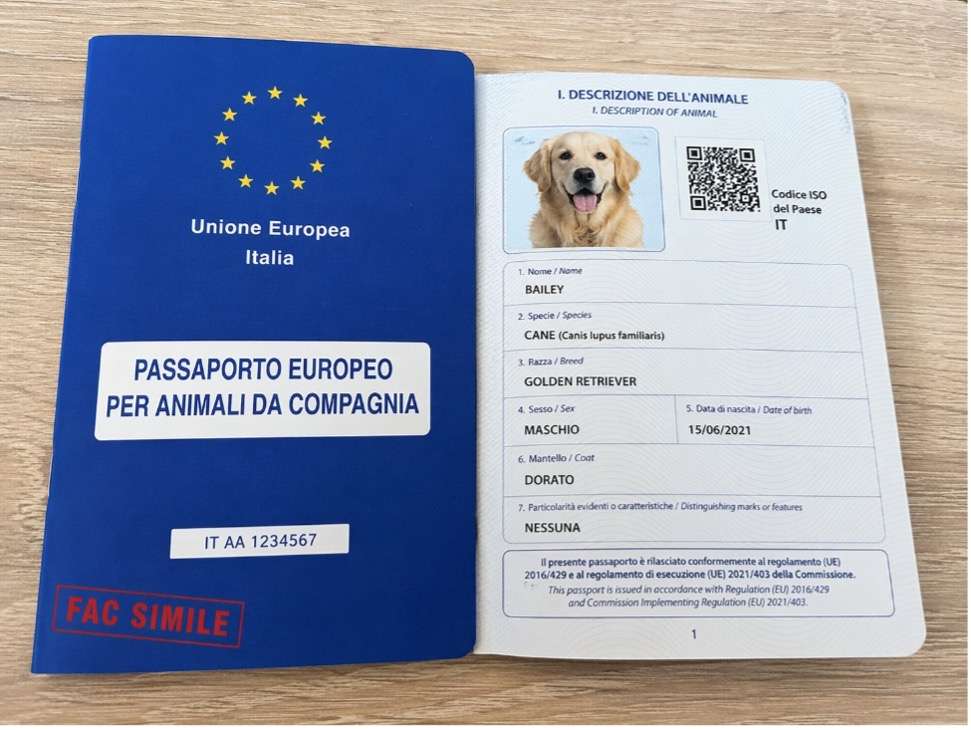
If your dog, cat or ferret already has a valid EU Pet Passport — with a registered microchip and an up-to-date rabies vaccination — you can enter Italy without any additional entry procedures.
The EU Pet Passport is the standard document across the European Union: an A6 blue booklet that contains the animal’s identification data, vaccination history and owner details. It is issued by authorised veterinarians in all EU countries and is valid for the animal’s entire life, as long as vaccinations are kept current. The only practical precaution needed before departure is checking that the rabies vaccination has not expired.
For those arriving from the EU, the critical point is not the journey but what happens after arrival in Italy: registering the dog with the regional animal register at the competent ASL (the local health authority). This is covered in the section on daily life in Italy.
Route B — From the USA, Canada, UK, Australia and other "listed" countries
These countries are classified by the EU as listed third countries: countries with a recognised low rabies risk profile. No blood test is required. The procedure takes approximately six weeks from the start of planning and depends on strict time windows that must be respected precisely.
A note for those moving from the United Kingdom: when the UK left the European Union in 2021, EU Pet Passports issued by British veterinarians ceased to be valid for bringing an animal from the UK to an EU country. This is not a recent change, but it continues to catch many owners off guard. The route for those departing from the UK follows the same rules as the other countries in this group, with some specificities described below.
Route C — From unlisted countries: the titre test and 5 months' wait
Those departing from a country not appearing on the EU’s lists of low-rabies-risk countries — among the most relevant for this guide’s readers: Brazil, Colombia, Ecuador, Venezuela, Bolivia, Paraguay, Uruguay, Qatar, Russia, India, China — must add a mandatory step to the standard procedure: the rabies antibody titre test, also known as the FAVN test (Fluorescent Antibody Virus Neutralization). This test measures the quantity of rabies antibodies present in the animal’s blood, verifying that the immune response to the vaccine has been effective.
Note: Argentina, Chile and Mexico are listed countries — no titer test is required. The list is subject to periodic revision: always verify the current status of your country on the European Commission portal before starting any procedure.
The sequence to follow (for Route B countries)
The microchip — always before the vaccine
The animal must be identified with a microchip conforming to international standard ISO 11784/11785: a 15-digit electronic device with a reading frequency of 134.2 kHz. This sequence admits no exceptions: the microchip must be implanted before any rabies vaccination is administered. If the sequence is reversed — vaccine first, then the chip — the vaccination is not recognised by the European authorities and must be repeated from scratch, with the entire waiting period that follows.
If your animal already has a chip of a non-ISO format — in the USA, 9-digit AVID chips were common and do not conform to the ISO standard — you have two options: implant a second ISO-compatible chip alongside the old one, or travel with a scanner compatible with the old format. For a permanent relocation, the second chip is the safer solution.
The rabies vaccine and the 21-day wait
Once the microchip is confirmed, the veterinarian can administer the rabies vaccine. The first vaccination an animal receives against rabies — or any vaccination following a lapse in coverage, even of just one day — is defined as a “primary vaccination” under EU rules. After a primary vaccination the animal must wait at least 21 days before it can enter Italy. Some vaccine manufacturers specify 30 days: in that case the longer period applies.
It is worth repeating because it causes frequent problems: if the booster vaccination is given late relative to the expiry of the previous coverage — even by a single day — the new vaccination is treated as primary. The previous coverage is not recognised and the count starts from zero.
A note on minimum age: the rabies vaccine can only be administered to puppies and kittens that are at least 12 weeks old. Adding the 21-day waiting period, the effective minimum age for entry into Italy is approximately 15 weeks. Italy, unlike some other EU countries, does not apply derogations for animals not yet fully immunised.
The official health certificate (Animal Health Certificate)
The document that allows the animal’s physical entry into Italy is called the Animal Health Certificate, abbreviated AHC. It is the official health certificate for non-commercial movements of companion animals into the European Union, in the format required by current EU legislation. It must be completed and signed by an authorised veterinarian in the country of origin, and then validated by the competent government veterinary authority of that country.
It is important to understand what these authorities are, because they go by different names in different countries:
- From the USA: the veterinarian must be accredited by the United States Department of Agriculture Animal and Plant Health Inspection Service, abbreviated USDA APHIS: the federal American veterinary service responsible for health controls on animals destined for export. The completed certificate is then submitted to USDA APHIS for validation — known as endorsement — through the online system called VEHCS (Veterinary Export Health Certification System). This step takes an average of 3 to 5 business days.
- From Canada: the veterinarian completes the certificate and submits it to the Canadian Food Inspection Agency (CFIA) for validation.
- From the United Kingdom: the certificate must be issued by an Official Veterinarian (OV), a figure with a specific government accreditation distinct from a regular vet. The cost is typically between £100 and £200. Unlike the EU Pet Passport — which once obtained is valid indefinitely — the British certificate is valid for a single trip only. Those relocating permanently from the UK to Italy who wish to travel freely in Europe afterwards will need to obtain an Italian EU Pet Passport from the local ASL once they have established residence.
- From Australia, Japan and other listed countries: the processes are equivalent, with the relevant national veterinary authorities.
A requirement specific to Italy: the bilingual certificate
Italy requires the AHC to be issued in bilingual form, in Italian and English. The standard English-only format — accepted by many other European countries — is not sufficient. This is one of the most common causes of problems at Italian customs. For travel from the USA, the bilingual version is not the standard one available automatically in USDA systems: it must be requested explicitly by emailing the USDA office responsible for exports, with sufficient advance notice before the veterinary appointment.
The time windows: a calendar that cannot be wrong
30 days — the maximum period within which the veterinarian can issue the certificate from the clinical examination. Do not book the appointment too far in advance of the departure date.
10 days — once the competent authority (USDA APHIS, CFIA or equivalent) has endorsed the document, the animal must arrive in Italy within 10 days of that date. If the journey is postponed beyond this window, the certificate expires and the process must start again from the beginning.
Once the animal has entered the European Union through customs, the certificate remains valid for intra-European travel for a maximum of 4 months from the date of the original clinical examination, unless the rabies vaccination coverage expires sooner.
Personal, non-commercial: what this means
EU law distinguishes two types of companion animal transfer: non-commercial movement — the case of someone bringing their own animal along during a personal relocation, with no intention of selling or transferring it — and commercial movement, which covers the transport of animals intended to change ownership.
This distinction is not merely formal: it determines which documents apply, which procedures must be followed and what costs are involved. Everything described in this guide applies to non-commercial movement.
To qualify as non-commercial, the owner of the animal, or a person expressly authorised in writing by the owner — a family member, a trusted friend — must travel with the animal or join it within five days. Five days before or five days after: the order does not matter, what matters is that the time gap between the animal’s journey and the person’s journey falls within this window. If it does not, the transfer becomes commercial automatically, with different and more complex requirements.
There is also a numerical limit: in the non-commercial regime it is possible to transport up to five animals per trip. The only exception applies to those participating in competitions, exhibitions or documented sporting events, with animals of at least six months of age: in that case the number may exceed five, but documentary proof of the event must be carried.
The sequence to follow (for Route C countries)
- ISO microchip — same requirement as the other routes, implanted before the vaccine.
- Primary rabies vaccination — same rules as Route B.
- Wait at least 30 days — from the day of vaccination, before the blood sample for the titre test can be taken.
- Blood draw and titre test — the sample must be analysed in a laboratory approved by the European Union. Not all laboratories are accredited: the European Commission portal maintains the updated list of authorised laboratories in each country. The result must show an antibody level of at least 0.5 IU/ml (international units per millilitre). If the result is below this threshold, the animal must be revaccinated and the test repeated 30 days later: the entire procedure starts over.
- Mandatory 3-month calendar wait — from the date of the blood draw. This is not an optional precautionary measure: it is a fixed regulatory requirement. Once the titre test has been passed with a positive result, it remains valid for the animal’s entire life, provided rabies booster vaccinations are administered without interruption.
- AHC health certificate — completed and endorsed by the competent authority of the country of origin, as in Route B.
The realistic timeline from Brazil and similar countries
Starting from an animal never vaccinated against rabies, the minimum process is approximately 4-5 months. But the 'minimum' assumes that every step happens on time, that the laboratory returns the result promptly and that the result is positive on the first attempt. For those moving from Brazil with an unvaccinated puppy, realistic planning requires at least 6 months of advance preparation.
Travelling: by air, road and train

By air
Available pet spaces on each flight are limited and sell out quickly in summer months. Booking must be made 6-8 weeks in advance, separately from the owner’s ticket. Rules vary significantly between airlines, but the general framework is: small dogs and cats with a combined weight (animal plus carrier) not exceeding roughly 8-10 kg can travel in the cabin. Medium and large dogs travel in the pressurised hold as checked baggage or cargo. Brachycephalic breeds — flat-faced dogs such as English and French bulldogs, pugs, boxers, and cats such as Persians — face increasing restrictions due to respiratory risks in the hold on transatlantic routes. Some airlines no longer accept them at all: check the specific policy before purchasing any ticket.
Regarding the arrival airport: for non-commercial movements Italy does not restrict entry to a small number of airports. For cargo or commercial transport it is necessary to identify the correct Border Control Post (BCP) for the route and species, in coordination with the airline or specialist transport agency.
By road
For those arriving from an EU country with a valid EU Pet Passport, entry by road is the simplest route. Keeping the animal’s documents readily accessible — not buried in luggage — is advisable for any border checks.
By train, within Italy
On Trenitalia, small dogs and cats carried in an appropriate container travel free of charge. Medium and large dogs travel with a dedicated ticket, on a lead and with the muzzle worn. Note the difference: on board the muzzle must actually be on the dog, not merely carried, because what applies here is not the general rule but the carrier’s conditions of carriage, which are stricter — and Italo requires the same. For urban public transport — buses, metro, trams — the rules are not uniform across Italy: each local transport operator has its own regulations, and in Milan ATM requires a lead and muzzle and bars access during peak hours, worth checking for the destination city before boarding.
Are you looking for assistance with relocating or purchasing a property in Italy? Discover all of Impatria’s services.

After arrival: the steps in Italy
Registering with the regional animal register
In Italy, dogs must be registered with the regional companion animal register in the region where they establish residence. Registration takes place at the ASL — the Azienda Sanitaria Locale, or Local Health Authority — competent for the area: the public veterinary service that manages, among other things, the identification and registration of companion animals in every Italian municipality.
The deadline for completing registration after establishing residence varies by region: there is no uniform national deadline. In some ASL offices in Piedmont and Liguria it is indicated as 15 days from arrival, but it may differ elsewhere. To find the competent ASL for your area, check the website of your region of residence under the section ‘Servizi veterinari’ (veterinary services).
Registration requires presenting the animal’s health documentation (EU Pet Passport or entry certificate), a valid identity document and your Italian tax code — the codice fiscale. If you have not yet obtained one, the dedicated guide explains how to apply from abroad.
Failure to register within the required deadline carries administrative sanctions. By way of example, in Piedmont Regional Law 18/2004 provides for fines of between €38 and €232 for specific omissions; the amounts vary by region.
The EU Pet Passport
Those arriving in Italy from outside the EU with an AHC do not yet hold a EU Pet Passport. Once Italian residence has been established, they can apply for one. The EU Pet Passport makes every future intra-European journey straightforward: no new health certificate, no procedure to repeat for travel to France, Germany, Spain or any other EU country.
In Italy the EU Pet Passport for companion animals is issued by the veterinary services of the ASL. To find the competent ASL for your area, check the website of your region of residence or the Italian Ministry of Health portal. Costs vary by region.
Finding a local vet
In Italy there is no centralised booking system: you simply choose a private veterinary practice near your home. It is useful to identify one before arrival, especially in rural areas or in municipalities where not all veterinarians speak your language.
Daily life with a pet in Italy
Dogs in public spaces
The unwritten rule that applies almost everywhere in Italy: unless there is a sign explicitly banning animals, your dog is welcome. This applies in bars, many restaurants, all kinds of shops. It is not tolerance: it is culture. The relationship Italians have with companion animals — dogs in particular — is structurally different from the northern European or Anglo-American norm, where the presence of animals in public spaces is far more regulated. This naturalness is, for many expats, one of the most immediate and pleasant surprises of the move.
Transport
Trains are described above. For urban transport: the rules vary by operator. Almost all major Italian cities admit animals in carriers, but the conditions — tariffs, permitted sizes, hours — differ from city to city. Check the rules of the local transport operator in your destination city.
Parks and beaches
Urban parks in Italy are generally accessible to dogs on a lead. Public beaches, especially in summer, often prohibit animals. Dedicated dog beaches are growing in number, concentrated particularly in Tuscany, Liguria, Puglia and Sardinia. A targeted search in your area will identify the nearest options.
Rental apartments
This is the most practical challenge of relocating with an animal. No Italian law obliges landlords to accept pets, and a significant proportion of those who rent prefer not to, especially with large dogs. The main property portals — Idealista.it and Immobiliare.it — allow searches to be filtered by ‘pets allowed’. Declaring the presence of the animal, its size and breed from the very first contact with a landlord is the most honest and effective strategy.
The climate
Italian summers, particularly from central Italy southwards, are long and very hot. Long-haired breeds and northern dogs suffer significantly in the heat. This is not necessarily an obstacle, but it is an element to consider when choosing your destination.
Rules for dogs in Italy
Italy has no national list of banned breeds: the ministerial decree that established one was repealed in 2009, and the current framework is based on the principle of responsible ownership. The obligations, however, are not shared out the way they are usually described. The Ministry of Health ordinance of 6 August 2013, renewed year after year and still in force, places two different duties on every dog, whatever its breed or size: the lead, no longer than 1.50 metres, must be used at all times in urban areas and places open to the public, except in the dog parks designated by the municipality; the muzzle, rigid or soft, must always be carried with you and fitted on the dog only if there is a risk to people or animals, or if the authorities ask for it (art. 1(3)). Lead and muzzle worn together at all times, plus a third-party liability policy, apply only to dogs entered by the veterinary service in the register of dogs assessed as being at high risk of aggression, after a bite or an attack (art. 3(4)). Assistance dogs for people with disabilities and livestock-guarding dogs are exempt from both (art. 5). Municipal regulations may be stricter — in Bologna and Turin, for instance, the muzzle must be worn inside shops: it is worth checking those of your destination municipality.
And other animals?
EU Regulation 576/2013 — the same rule that governs the movement of dogs, cats and ferrets — lists in Annex I, Part B, the other animal species that may travel with their owner as companion animals: invertebrates (excluding bees, bumblebees and molluscs), ornamental aquatic animals, amphibians, reptiles, birds other than poultry, and among mammals, rodents and rabbits not intended for food production.
For these species the regulatory framework differs in one important respect: there is no EU-harmonised document system comparable to the EU Pet Passport. The regulation allows each member state to apply its own national rules for the entry of these animals, and Italy has specific requirements — in particular for birds, which are subject to veterinary controls at Border Inspection Posts (BIPs) under Italy’s avian influenza legislation.
For all animals other than dogs, cats and ferrets, Italian Law 150/1992 also applies. This law implements the international Convention on International Trade in Endangered Species of Wild Fauna and Flora, known as CITES. This is not limited to rare or exotic species: it applies to all species whose international trade is regulated. Before planning a relocation with an animal other than a dog, cat or ferret, it is essential to verify whether the species falls under CITES regulation and, if so, what documents and permits are required.

Conclusion
Italy rewards those who prepare. Not because it puts up obstacles, but because its rules are precise and leave no margin for approximation. A dog arriving from the USA with all documents in order, in the right sequence, with the bilingual certificate and the USDA validation obtained on time: crosses the border without a question. The same dog, with a certificate in English only or arriving on the eleventh day after validation: is stopped.
The starting point is not the veterinarian, and it is not the certificate. It is knowing which country you are leaving from. Those arriving from the European Union have a simple process ahead of them, beginning and ending with the EU Pet Passport. Those arriving from the USA, Canada, Australia or the UK need about six weeks of planning. Those arriving from Brazil, Colombia or other unlisted countries have a journey of at least five months ahead — more realistically six — including a blood test at an accredited laboratory and a mandatory three-month wait.
Once the border is crossed, the discovery is that Italy delivers everything it promises for those living with an animal. The dog that at home required awkward conversations with bar owners is here welcomed as an obvious part of the company. It is not a marginal detail of daily life: for many expats, it is one of the fastest and most pleasant adjustments of the entire Italian experience.
Share on:
Faq
You need: an ISO 11784/11785 microchip implanted before the rabies vaccine; the rabies vaccination with at least a 21-day wait after the primary shot; a bilingual Italian-English AHC health certificate, completed by a USDA-accredited veterinarian and endorsed by USDA APHIS (3-5 business days via the VEHCS system). The animal must arrive in Italy within 10 days of endorsement. The USA is on the EU's list of listed countries: no blood test required. Plan at least 5-6 weeks in advance.
Brazil is an EU unlisted country, so the rabies antibody titre test is mandatory. The full sequence is: ISO microchip → rabies vaccination → 30-day wait → blood draw at an EU-approved laboratory → if the result is ≥ 0.5 IU/ml, a mandatory 3-month wait → AHC health certificate endorsed by the competent Brazilian authority (MAPA/SDA) → departure. From the first vaccination to entry into Italy the minimum time is approximately 4-5 months under ideal conditions. Plan at least 6 months in advance.
Since 1 January 2021, EU Pet Passports issued by British veterinarians are no longer valid for UK→EU travel. You need an Animal Health Certificate (AHC) issued by a UK Official Veterinarian (OV), valid for a single trip, at an approximate cost of £100-200. The process requires: ISO microchip → rabies vaccination (21 days before departure) → AHC issued by the OV within 10 days before travel. No titre test required: the UK is an EU-listed country. Once residence is established in Italy, an Italian EU Pet Passport can be obtained from the local ASL for all subsequent journeys.
Dogs, cats and ferrets follow the same EU rules. The route depends on the country of departure: a valid EU Pet Passport for those arriving from the EU; an AHC health certificate for those arriving from the USA, UK, Canada or Australia; the titre test and a 3-month wait for those arriving from unlisted countries such as Brazil. Cats do not require antiparasitic treatment against tapeworm (required only for dogs entering certain countries such as Finland, Ireland and Malta — not Italy).
Canada and Australia are EU-listed countries: no titre test required. The procedure is the same as for the USA: ISO microchip → rabies vaccination (21-day wait after the primary shot) → AHC health certificate endorsed by the competent authority (CFIA for Canada, DAFF for Australia) → arrival in Italy within 10 days of endorsement. Italy requires the certificate in bilingual Italian-English form: confirm with the veterinarian that the correct version is available before proceeding.
No, if all documentation is correct, complete and follows the mandatory sequence. Where there is an irregularity — missing or expired certificate, English-only version instead of the required bilingual form, or a wrong microchip-vaccine sequence — authorities can detain the animal, refuse its entry or impose a quarantine at the owner's expense.
Every Italian municipality is assigned to a specific ASL (Azienda Sanitaria Locale, or Local Health Authority). To find the one competent for your area, search the website of your region of residence under 'Servizi veterinari' (veterinary services), or consult the Italian Ministry of Health portal. The ASL's veterinary service is the office where you register the dog in the regional canine register and where you apply for the EU Pet Passport.
Yes, but with different procedures from those for dogs and cats. Birds, reptiles, rodents and amphibians fall under Annex I, Part B of EU Regulation 576/2013, but do not have a harmonised document system like the EU Pet Passport. Italy applies specific national rules, particularly for birds subject to veterinary controls for avian influenza. For many exotic species the CITES Convention also applies: before planning the move it is essential to verify whether the species is regulated and what documents are required.